

Once a buyer has decided what chemistry they need, the next question is how to source it: buy a standard product off the shelf, have an existing formulation private-labelled under their own brand, or commission a genuinely custom formulation for their line. The three routes differ substantially in cost, lead time, risk, and ongoing management. This article sets out the trade-offs honestly, including the cases where custom development is not worth the effort.

Three supply models, defined
| Off-the-shelf | OEM / private label | ODM / custom formulation | |
|---|---|---|---|
| What you get | Standard catalogue product | Standard formulation under your brand | Formulation developed for your line |
| Chemistry | Fixed | Fixed | Tailored |
| Development cost | None | Low (packaging and labelling) | Moderate to high |
| Lead time | From stock, days | Days to a few weeks | Typically weeks to months |
| Minimum order | Low | Moderate | Higher |
| Branding | Supplier's | Yours | Yours |
| IP ownership | Supplier | Supplier (licence to you) | Negotiable |
| Best for | Standard needs, trials, small volumes | Distributors and resellers | Unusual substrates, process fit problems |
Off-the-shelf: correctly judged, not a compromise
There is a persistent assumption that off-the-shelf products are what you buy when you cannot afford better. In metal surface treatment, that is usually wrong. The industry has produced a large family of well-optimised standard chemistries precisely because most production lines face the same handful of problems: removing drawing oil from steel, passivating 304 stainless steel after welding, phosphating before powder coat, degreasing aluminium without etching it.
Standard products win in four situations:
- Your problem is a common one. If you are passivating 300-series stainless steel to a blue dot test standard, there is no benefit in commissioning a bespoke formulation — the standard product already meets the requirement. LG303 Stainless Steel Two-in-One Passivation Agent exists precisely for this case.
- You want to test before you commit. Purchasing a standard product to evaluate on your own parts is the lowest-cost way to establish whether a supplier's chemistry suits your line at all.
- Your volumes are small or intermittent. Development cost has to be amortised over volume. Below a certain annual consumption, custom development never pays back.
- You value batch-to-batch consistency above marginal performance. High-volume standard products are typically produced in larger batches with well-established control limits.
OEM and private label: branding without development risk
OEM supply takes an existing, validated formulation and puts your identity on it. For distributors, trading companies, and companies building a product line around their own brand, this is usually the right model. The chemistry is already proven; the cost and risk lie in packaging, labelling, and documentation rather than in development.
What to confirm in an OEM arrangement:
- Documentation package. Can the supplier provide MSDS, technical datasheets, and ISO / RoHS documentation in your brand's context, in the languages your market requires?
- Consistency guarantee. Ask for the specification range the product is controlled to, and whether you will be notified before any formulation change.
- Packaging flexibility. Drum sizes, labelling format, and whether custom printed labels are possible.
- Exclusivity. Whether the supplier will sell the same formulation under another brand in your territory. Most will not offer territorial exclusivity on a standard product; some will for a committed volume.
For a distributor building a catalogue, a private-labelled range that includes cleaning, passivation, and sealing chemistry in matching packaging — built around established formulations such as LG909 Ceramicizing Agent or LG912 Neutral Sealant — is a faster and lower-risk route to market than developing new chemistry.

ODM and custom formulation: when it genuinely pays
Custom development is justified when a standard product fails for a reason that is structural to your process, not incidental. Legitimate triggers include:
- An unusual substrate or alloy where standard formulations produce unacceptable results — certain high-silicon die-cast alloys, high-copper free-cutting stainless grades, or magnesium components.
- A specific acceptance test that standard products miss — for example, an unusually long salt spray requirement, a conductivity requirement that rules out certain film chemistries, or a customer-specific cleanliness specification.
- A process constraint the standard product cannot meet — a spray line that requires lower foam than the standard immersion product generates, or a line with fixed temperature limits below the standard product's effective range.
- A regulatory constraint — a market that restricts a substance present in the standard formulation.
- A distinctive commercial position. If your business depends on offering something competitors cannot source off the shelf, a custom formulation is a genuine asset.
The chrome-free transition is a good illustration. Where a market or customer restricts hexavalent chromium, an existing chrome-free product such as LG908 Chrome-Free Passivation Agent may satisfy the requirement without development. Only where the chrome-free standard product cannot hit the required performance window does a bespoke formulation become worth commissioning.
The realistic cost of custom development
Buyers routinely underestimate the total effort. A properly run ODM project involves:
| Stage | What happens | Who is involved |
|---|---|---|
| Requirement capture | Substrate, soil, method, temperature, acceptance test, volumes | Buyer process + supplier technical |
| Lab formulation | Candidate formulas screened on coupons | Supplier laboratory |
| Coupon validation | Corrosion, adhesion, appearance testing | Supplier laboratory |
| Line trial | Sample run on the buyer's actual parts and equipment | Both parties, on site |
| Parameter setting | Concentration, time, temperature, replenishment logic | Both parties |
| Documentation | Datasheet, MSDS, compliance documentation | Supplier |
| Scale-up | Production batch, packaging, delivery | Supplier |
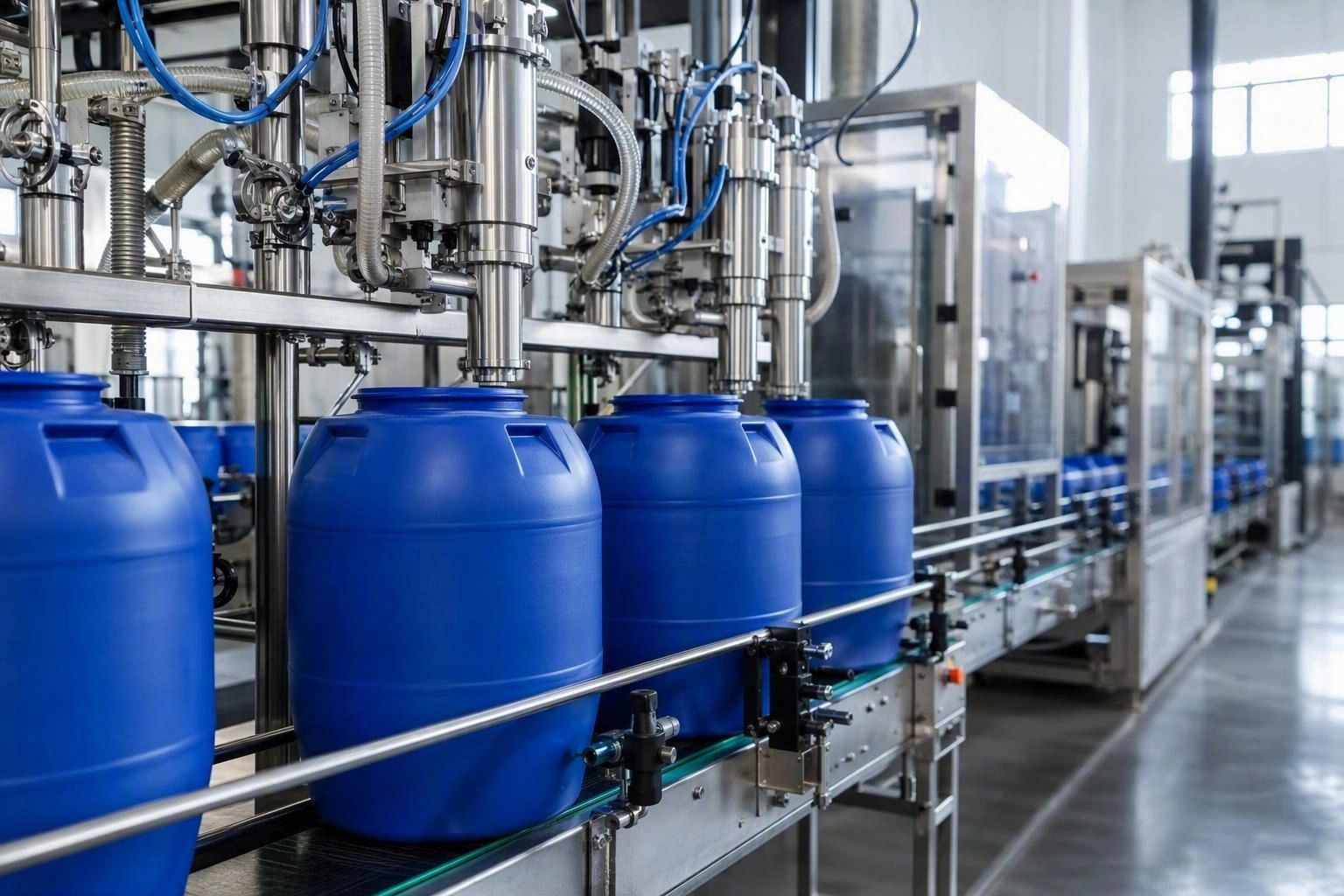
The decisive stage is the line trial. A formulation that performs perfectly on coupons frequently needs adjustment once it meets real part geometry, real soil loading, and real rinse water. Buyers should budget for at least one iteration.
A decision path that avoids over-engineering
- Start with the standard product. Buy a sample of the closest catalogue match and test it on your own parts. This costs very little and resolves most questions.
- If it nearly works, ask whether the gap is fixable by process adjustment. Concentration, time, temperature, and rinse quality solve a surprising share of apparent product failures. A supplier should be able to advise here at no cost.
- If it clearly does not work, quantify why. "It failed" is not a specification. "It produced dark smut on die-cast aluminium at 40 °C with a two-minute immersion" is.
- Choose OEM if the only gap is branding. Do not commission development for a labelling outcome.
- Commission ODM only when the requirement is structurally outside the standard product range, and when your annual volume justifies the development investment.
How we work with buyers
Foshan Changcheng Surface Technology operates on all three models. Our standard range covers passivation agents, chrome-free passivation agents, ceramicizing agents, silane sealants, neutral and alkaline cleaners, phosphating agents, surface modifiers, and demolding agents. We will recommend a standard product where one fits, provide private-label supply where branding is the driver, and develop custom formulations where the requirement genuinely falls outside the standard range.
To start, send us your substrate, soil, process method, available temperature, and acceptance test. We will tell you honestly whether a standard product will do the job, and supply samples for trial on your own line. Technical datasheets, ISO / MSDS / RoHS documentation, and electronic catalogues are available on request.


