

Few things in stainless steel finishing are as discouraging as a part that comes out of a passivation bath looking perfect, then fails a test. The test result is real, but the cause is usually not the chemistry in the tank. In most cases, the failure originated one or more stages earlier. This article works through the seven causes we encounter most often, in roughly the order of frequency, along with the specific corrective action for each.
Quick background: what the test measures
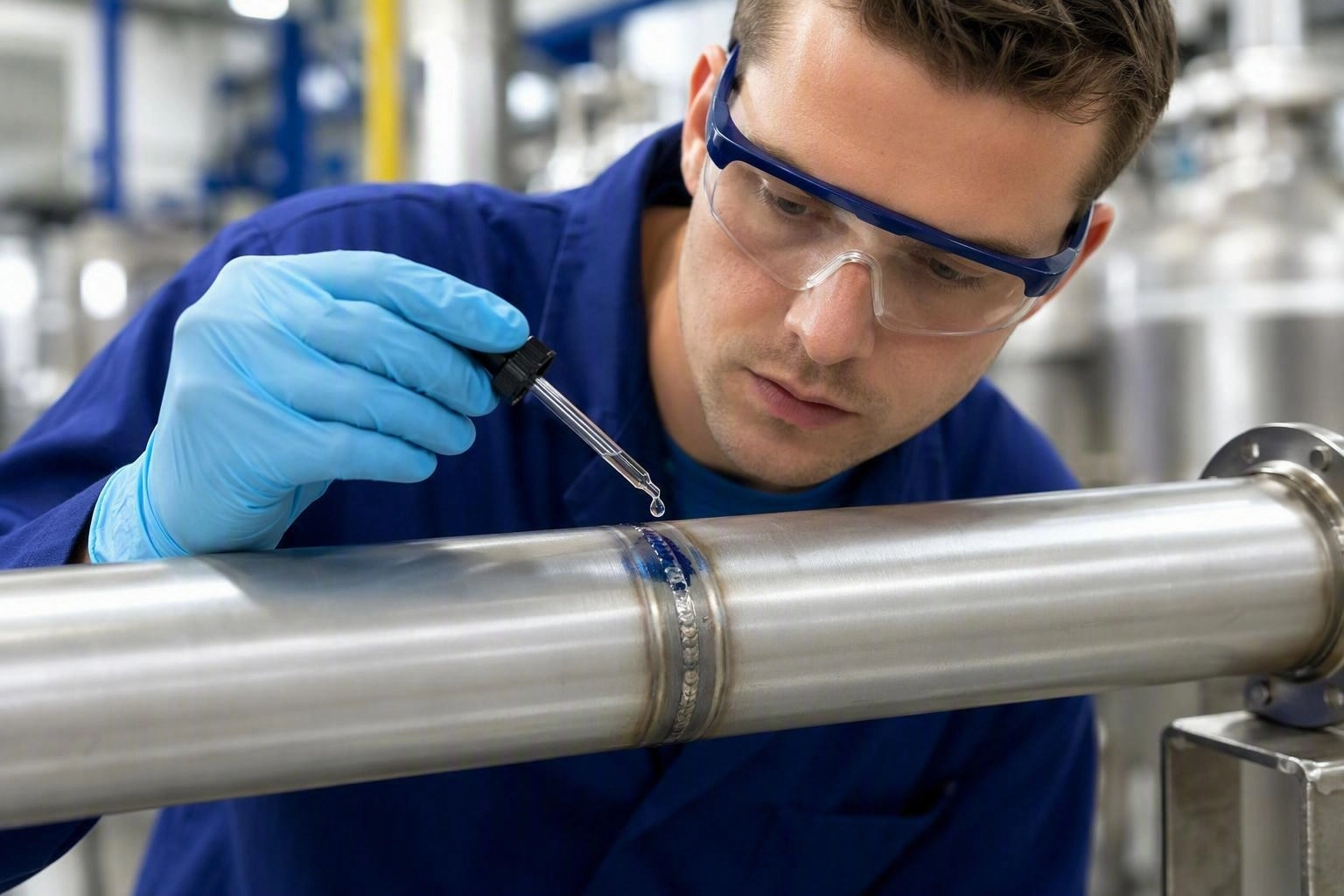
The blue dot test (also called the ferroxyl test) applies a solution containing potassium ferricyanide to the treated surface. Any free iron present reacts to form a deep blue colour (Prussian blue). The presence and density of blue dots is a direct indication of free iron contamination on the surface.
The key point is that the test measures free iron on the surface, not the quality of a film. That distinction explains why most failures are actually failures of cleaning, rinsing, or handling rather than of passivation chemistry.
Cause 1: Inadequate pre-cleaning — oil left on the surface
The single most common cause. Passivation is a surface reaction. If an oil film is present, the reaction happens to the oil, not the metal underneath. The part looks treated and fails the test.
How to confirm: Perform a water-break test after the pre-clean and rinse stages. The surface should hold an unbroken, continuous water film for at least 30 seconds. If the water beads or pulls away, oil is present.
The fix: Remove heavy oil, drawing compound, and polishing paste with an alkaline degreaser first, and rinse thoroughly until the continuous-water-film condition is met. A two-in-one chemistry such as LG303 Stainless Steel Two-in-One Passivation Agent handles light anti-rust oil, fingerprints, and dust directly — but it is not designed to cope with heavy grease or polishing compound, and cannot substitute for proper pre-cleaning where those are present.
Cause 2: Oxide scale and heat tint not removed before passivation
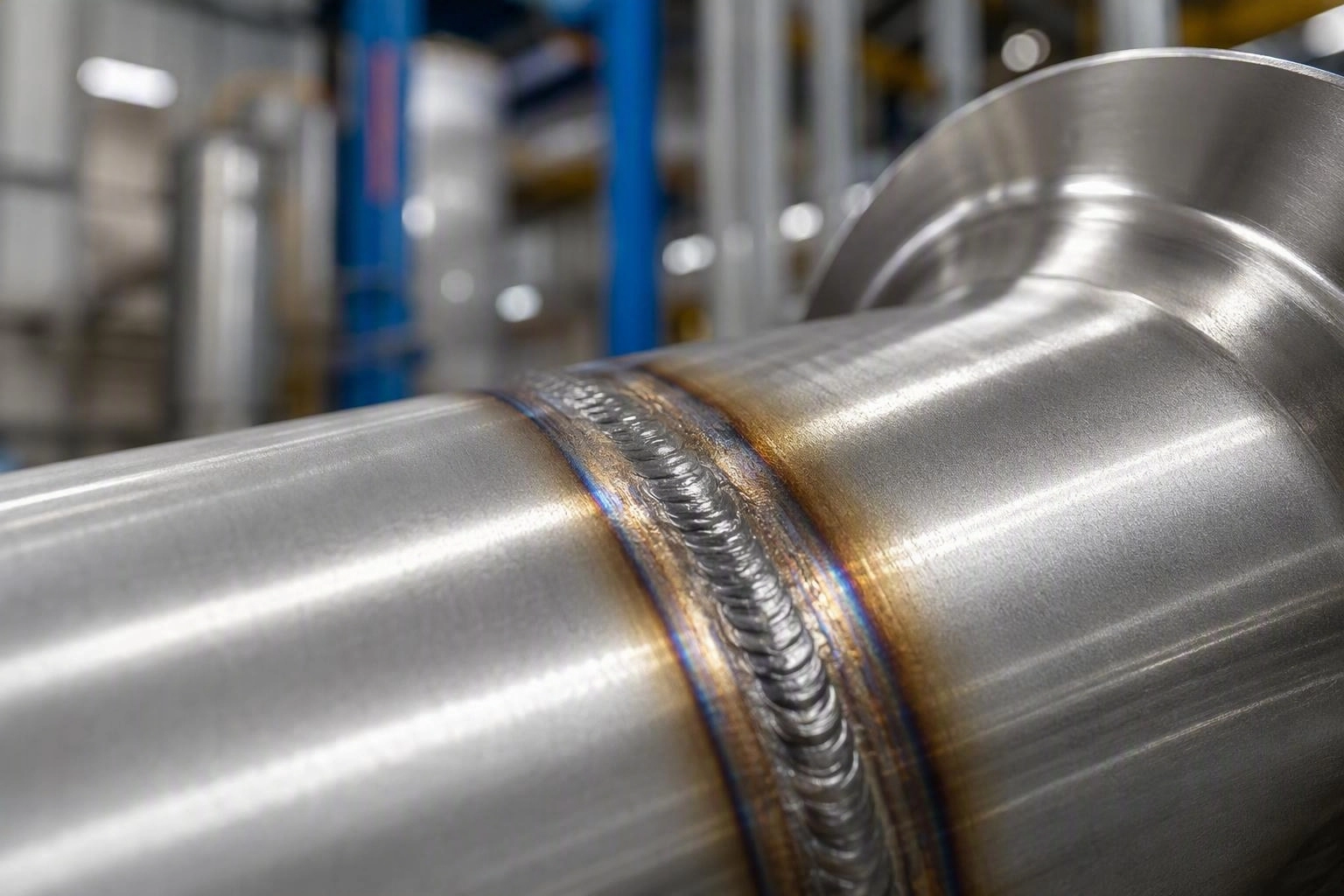
Welding, laser cutting, and heavy grinding leave oxide scale on stainless steel. The visible heat tint is not merely cosmetic: the coloured zone is depleted in chromium, and its corrosion resistance is genuinely lower than the base metal. Passivation cannot rebuild a chromium-depleted zone — that requires the oxide to be removed first.
How to confirm: Visual inspection under good light. Heat tint appears as blue, purple, or straw-coloured bands along weld beads and heat-affected zones. Any visible colour is a warning sign.
The fix: Mechanical descaling (grinding, brushing with stainless-only tools) or a dedicated pickling or descaling step before passivation. Passivation then restores the now-exposed surface. Note that this is a sequence, not a choice — the pickling removes the damaged layer, and the passivation restores and stabilises the freshly exposed chromium oxide.
Cause 3: Embedded iron from tooling and handling
Free iron gets embedded into stainless steel by carbon steel tooling, wire brushes, grinding wheels previously used on carbon steel, steel racking, and even steel shot in blasting media. The embedded particles are the source of the blue reaction, and they sit below the surface, which is why the passivation bath does not simply remove them.
How to confirm: The blue reaction appears as scattered dots, often concentrated in areas that were machined, brushed, or contacted by racking — weld seams, edges, and contact points.
The fix: Establish a dedicated stainless-only tool policy. Separate brushes, wheels, racks, and jigs. Where contamination is already present, a longer or more aggressive passivation treatment may be needed, and in severe cases mechanical removal followed by re-passivation is the only reliable route. Products formulated with a stronger activating component, such as LG908 Chrome-Free Passivation Agent, are designed to cope with more demanding surface conditions, but tool segregation prevents the problem entirely and costs nothing.
Cause 4: Insufficient immersion time or temperature
Passivation is not instantaneous. The reaction needs time to dissolve free iron from the surface and to allow a uniform chromium oxide layer to re-form. Recommended process windows are real limits, not suggestions.
| Condition | Typical effect |
|---|---|
| Time below recommended minimum | Incomplete iron removal; scattered blue dots |
| Temperature below recommended range | Reaction slows markedly; same effect as short time |
| Concentration below specification | Reduced activity; inconsistent results across a load |
| Excessive time or temperature | Over-treatment, dulled appearance, surface attack |
The fix: Verify the actual bath temperature with a calibrated instrument rather than trusting the setpoint, and confirm the concentration by the recommended method. A 50 % working solution soaking for 5–15 minutes at room temperature is the standard starting point for a two-in-one passivation process; results at 10 °C ambient in an unheated workshop in winter will be noticeably worse than the same parameters at 30 °C.
Cause 5: Incomplete rinsing and residual contamination
Residual treatment chemical trapped in crevices, weld seams, blind holes, and lap joints is a frequent and often misdiagnosed cause of what appears to be passivation failure. The trapped liquid continues to react, or dries to leave a residue that reads as contamination.
How to confirm: The failure concentrates in specific locations — seams, crevices, low points — rather than being distributed evenly across the part.
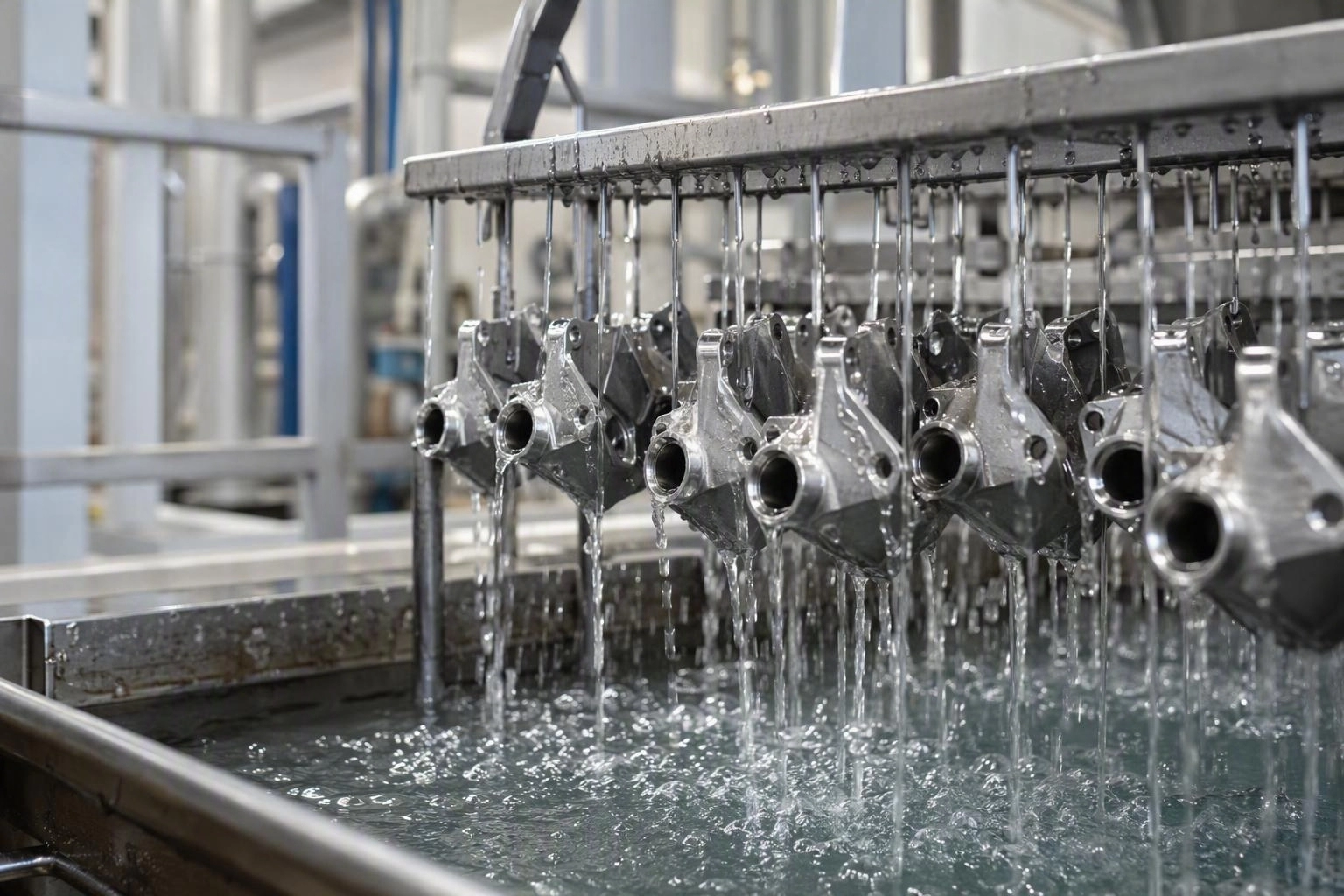
The fix: Improve access for rinse water, extend rinse time, use deionised or RO water for the final rinse, and ensure adequate drainage from the moment the part leaves the tank. Where parts trap liquid, jigging orientation matters as much as rinse duration.
Cause 6: Base metal issues — unsuitable grade or prior contamination
Some stainless steel grades are simply not suited to certain passivation formulations. Free-cutting grades such as 303 and 430F contain elevated sulphur or copper to improve machinability, and these additions interfere with the formation of a uniform passive layer. Copper and sulphur inclusions react differently from the surrounding matrix.
How to confirm: Check the material certificate. If the part is a free-cutting grade, or if it is a casting with significant porosity, the passivation behaviour will differ from a wrought 304 part.
The fix: Confirm the grade before specifying a treatment. For free-cutting grades, discuss the specific application with your supplier — a standard stainless passivation formulation may not be appropriate. Also verify that the part has not been previously treated with a coating or conversion film that is interfering with the passivation reaction.
Cause 7: Post-treatment contamination
Failures can also be created after the bath. Handling with bare hands transfers oils and salts. Storing parts in contact with carbon steel, or in an environment with airborne iron dust (grinding areas, fabrication shops), re-contaminates a perfectly passivated surface. Cutting fluids applied afterwards can also interfere with subsequent testing.
The fix: Handle treated parts with clean gloves, use stainless or plastic racking and packaging materials, and store away from grinding and cutting operations. If parts must be stored for an extended period, specify an appropriate protection method rather than leaving them unprotected.
Diagnostic sequence
Working through causes in this order resolves the majority of failures in one pass:
- Check the material certificate — confirm the grade is suitable for the intended passivation treatment.
- Check cleanliness with a water-break test. If the surface does not hold a continuous water film, stop here. Cleaning is the problem.
- Inspect for oxide and heat tint. Visible colour on welds means descaling is required before passivation.
- Check for a stainless-only tool policy. If carbon steel tools or racking touch the parts, embedded iron is a likely contributor.
- Verify bath parameters — temperature by instrument, concentration by method, immersion time by clock. Not by memory.
- Examine the failure pattern. Localised failures point to rinse or drainage issues; evenly distributed failures point to chemistry, time, or contamination.
- Review post-treatment handling. Gloves, racking, packaging, and storage.
Preventing recurrence
Most of these causes are cheap to prevent and expensive to discover. Three routine measures eliminate the majority of them: a documented pre-clean step verified by water-break test; a stainless-only tool and racking policy; and a simple daily record of bath temperature, concentration, and immersion time.
Foshan Changcheng Surface Technology supplies stainless steel cleaning and passivation chemistry including LG303 Stainless Steel Two-in-One Passivation Agent, LG908 Chrome-Free Passivation Agent, and LG607 Alkaline Degreaser, along with process guidance for the stages around them. If you send us details of a failing part — grade, contamination, process parameters, and the test result pattern — we will help identify the most likely cause and the corrective action. Technical datasheets, ISO / MSDS / RoHS documentation, and electronic catalogues are available on request.


