

Automotive parts present a combination of requirements that few other industries impose at once: high production volumes, tight dimensional tolerances, multi-material assemblies, and corrosion specifications that are validated by test rather than by appearance. The surface treatment sequence carries a disproportionate share of the risk, because defects introduced there do not appear until after coating, or until a salt spray chamber runs for several hundred hours.
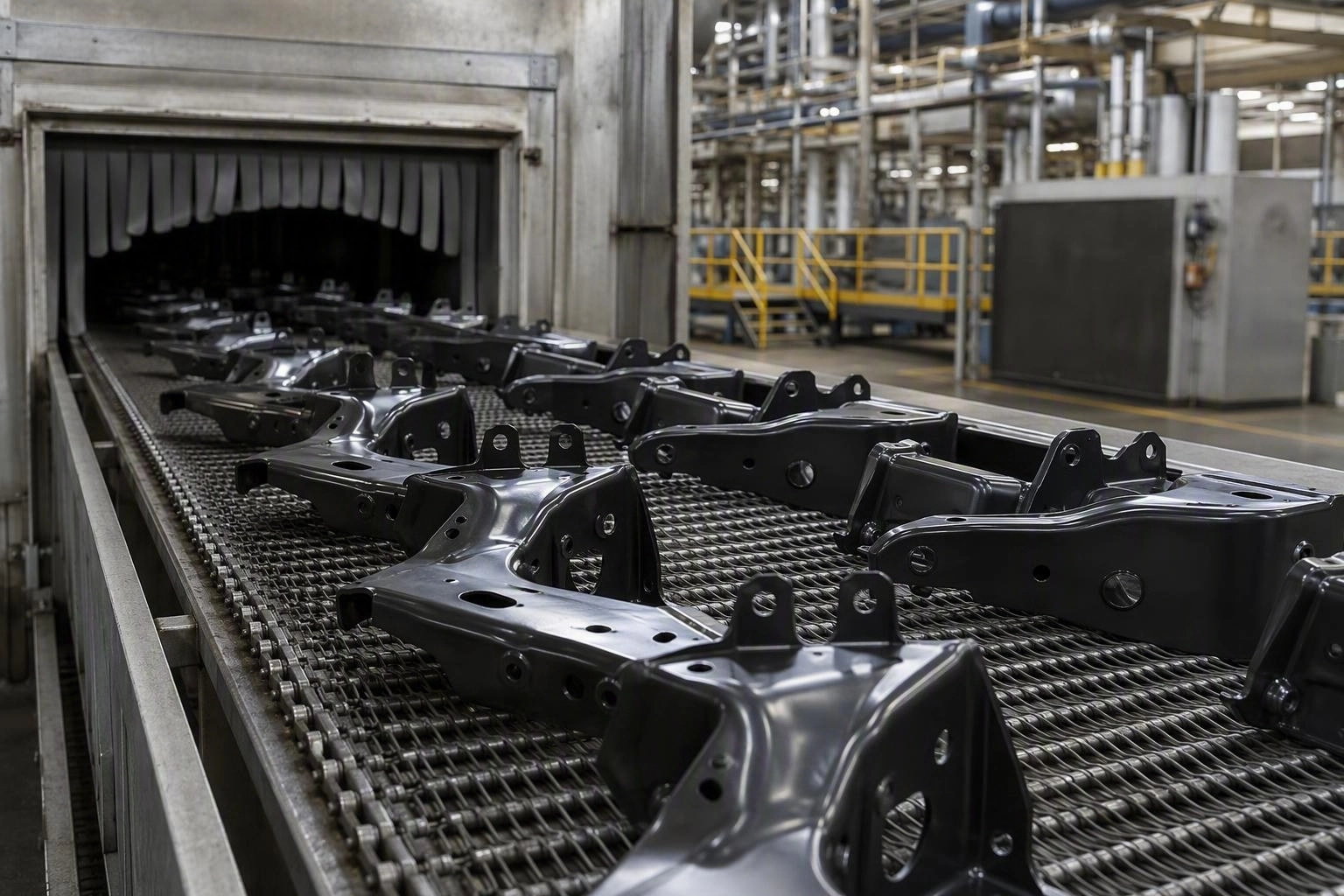
The part families and what each demands
| Part family | Typical material | Surface treatment driver |
|---|---|---|
| Stamped body brackets, reinforcements | Cold-rolled and galvanised steel | Drawing oil removal; phosphate or conversion layer for paint adhesion |
| Suspension and chassis components | Forged and cast steel | Scale and rust removal; heavy-duty corrosion protection |
| Die-cast housings (engine, transmission, e-housing) | AlSi die-cast aluminium | Silicon smut removal; conversion coating before sealing or painting |
| Fasteners | Carbon steel, alloy steel, stainless | Bulk processing; consistent coverage at high volume; salt spray hours |
| EV battery housings and busbars | Aluminium, copper | Cleanliness; conductivity preservation; thermal interface compatibility |
| Trim and decorative parts | Aluminium, stainless | Appearance consistency; bright finish; adhesion for clear coat |
The most consequential split is between steel and aluminium work, because the two require different chemistry and frequently run through the same shop.
Steel parts: from stamping oil to coating adhesion
The sequence for a stamped steel automotive part typically runs: alkaline degrease → rinse → conversion coating → rinse → (seal) → dry → powder or e-coat.
The critical stage is the conversion coating, and it exists for a specific reason: paint and powder need a surface they can mechanically and chemically key into, and bare steel provides neither reliably nor consistently. A phosphate layer provides that key, and it also contributes a corrosion barrier of its own.
Two things commonly go wrong:
- Incomplete oil removal before phosphating. Stamping oils and drawing lubricants are tenacious, and if any remains, the phosphate crystals cannot form on that area. The result is a bare patch under the paint — invisible at inspection, visible as a blister or a scribe-creep failure after salt spray. Verifying with a water-break test after the cleaning rinse is the cheapest available control.
- Free-flake phosphate coatings. If the phosphating reaction runs outside its control window, the coating grows as loose, powdery crystal that adheres poorly and produces dust in the tank. The coating looks present in cross-section but performs badly under impact and bend testing. LG408 Free-Flake Zinc Phosphating Agent is formulated to control crystal growth so the layer deposits as a fine, uniformly adherent coating rather than loose flake — a difference that shows up directly in bend and impact test results.
Where the specification permits a lighter conversion layer or where the substrate is mixed, LG338 Acidic Degreasing Agent supports the pre-clean stage on steel workloads where rust and scale accompany the oil, so that cleaning and light descaling occur in a single stage before the coating step.
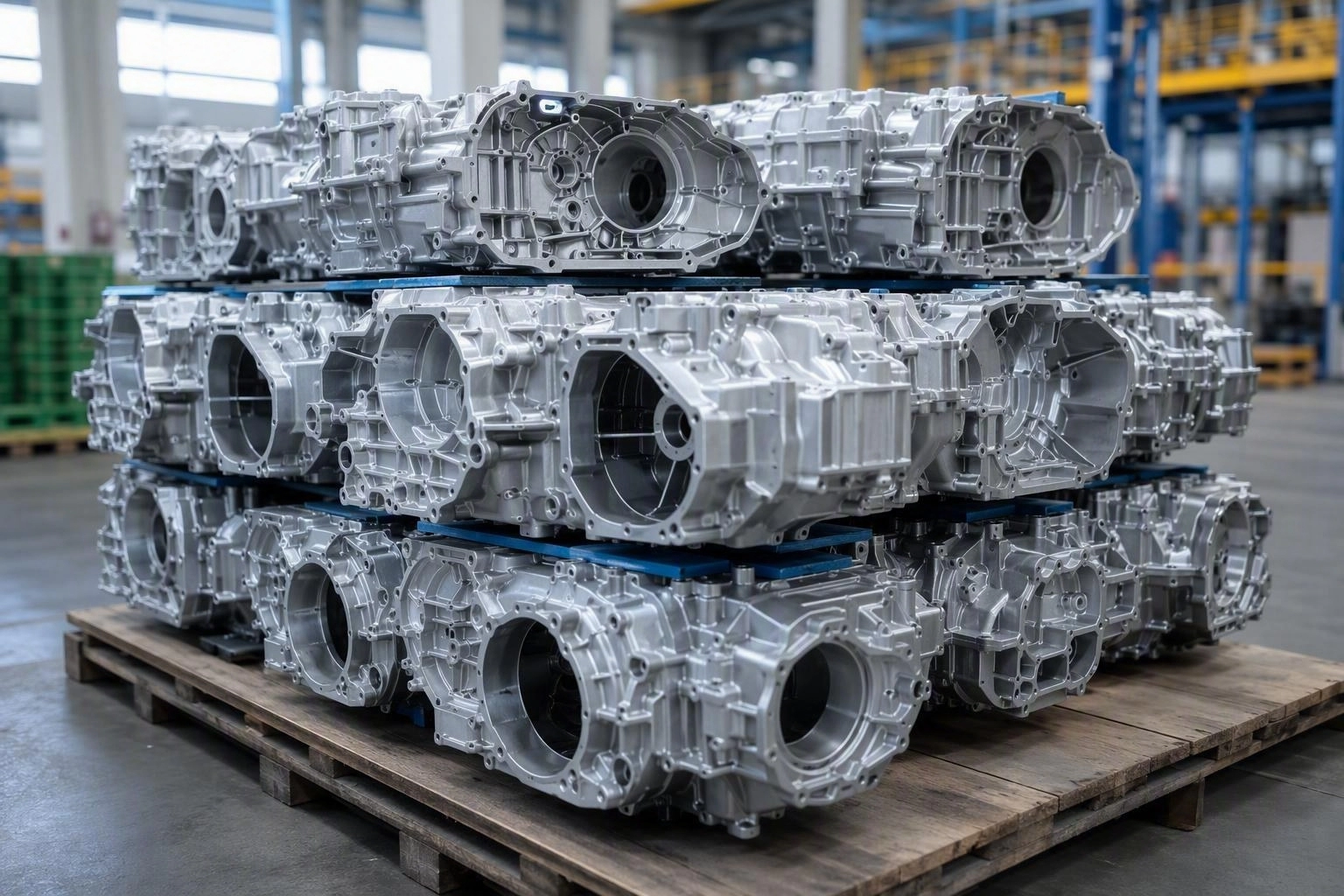
Aluminium parts: the silicon smut problem
Die-cast aluminium behaves very differently from steel, and most of the difficulty comes from alloy composition. AlSi alloys contain silicon phases that do not dissolve in alkaline cleaners. When the aluminium matrix around them is cleaned, the silicon is left behind as a dark, adherent smut.
This has three consequences:
- Appearance. The part looks unclean even after correct cleaning, which drives operators to extend cleaning time or increase concentration — both of which increase etching without solving the problem.
- Adhesion. A conversion coating applied over silicon smut does not bond to the metal; it bonds to the smut. The coating appears to form and then fails at the smut interface.
- Corrosion. The smut layer itself is not protective, and it creates a local electrochemical difference that promotes corrosion.
The corrective approach: use an acidic deoxidising or desmutting stage rather than trying to clean the problem away with alkaline chemistry. Acid dissolves the silicon-containing surface layer and exposes clean aluminium. This is precisely the role of LG808 Aluminum Spray Acidic Degreasing Agent, which combines oil removal with acidic action on aluminium in a spray application, and of LG809 illuminant for brightening the aluminium surface after treatment.
Once the surface is genuinely clean aluminium, a conversion coating can form properly. LG908 Chrome-Free Passivation Agent is frequently specified here for automotive work because OEM specifications increasingly restrict hexavalent chromium, and a chrome-free conversion layer satisfies both the performance requirement and the restricted-substance list.
Salt spray performance: what actually drives the hours
Salt spray results in automotive work are frequently discussed as if they were a property of the coating. They are not. The hours achieved depend on the whole stack.
| Layer | Contribution to salt spray performance | Common failure mode |
|---|---|---|
| Substrate | Provides the base corrosion resistance | Contamination embedded in the surface |
| Pre-clean | Determines whether the conversion layer can form | Residual oil → bare patches → blistering |
| Conversion coating | Barrier plus adhesion key | Free-flake or incomplete coverage |
| Seal / post-rinse | Closes porosity in the conversion layer | Skipped to save a stage |
| Topcoat (paint / powder / e-coat) | The main barrier | Adhesion failure initiated at the conversion layer |
The practical conclusion is that improving salt spray hours usually means improving the layers underneath the coating, not the coating itself. Scribe creep and blistering are adhesion failures, and adhesion failures almost always trace back to the pre-clean or conversion stage.
Bulk processing and fasteners
Fasteners and small hardware are processed in bulk, either in barrels or on vibratory equipment. Three considerations dominate:
- Coverage. Parts in contact with each other do not receive treatment on the contact areas. Barrel rotation and load ratio determine coverage quality, and overloading a barrel is a common cause of patchy results.
- Drag-out and cross-contamination. Bulk processing carries more solution out of each tank, so drag-out rinses and rinse water quality matter more, not less.
- Consistency. Because individual part inspection is impractical, the process must be controlled by parameter rather than by inspection. Bath concentration, time, and temperature need to be held tightly.
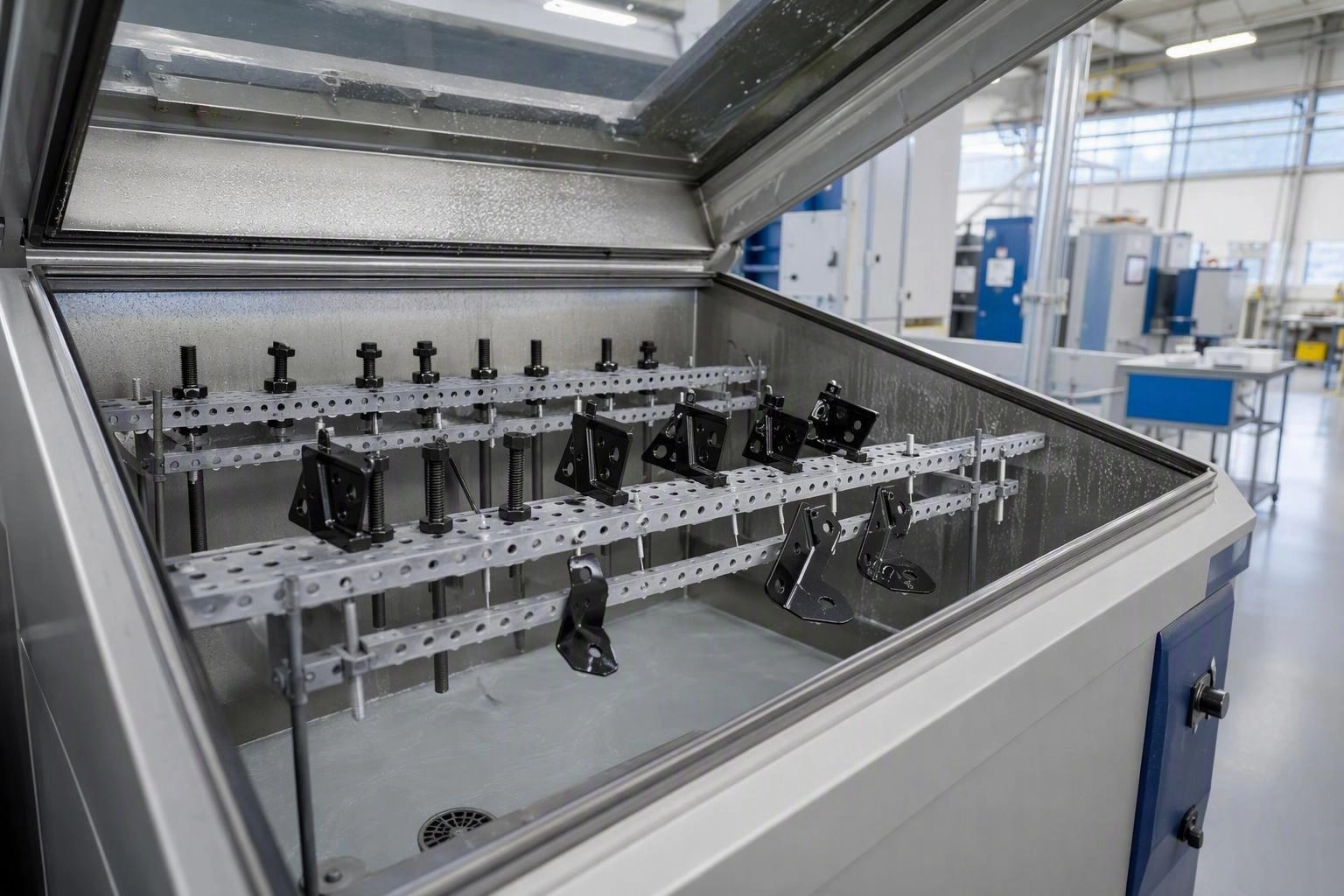
EV-specific considerations
Electrification has introduced new requirements that standard automotive surface treatment specifications did not previously cover:
- Conductivity of busbars and connectors. Treatments that add a resistive film are unsuitable. Cleaning and passivation chemistries that preserve conductivity are required.
- Thermal interface compatibility. Surfaces that will receive thermal paste or gap filler must be free of residues that degrade heat transfer.
- Battery housing sealing. Conversion coatings and seals must be compatible with the adhesive and gasket systems used in enclosure sealing, and must perform across a wide temperature range.
- Cleanliness specifications. Particulate and ionic cleanliness requirements on battery and power electronics components are considerably tighter than traditional automotive standards.
A workable specification sequence
- Confirm substrate and grade for every part family. Do not assume a single process covers steel, galvanised, and die-cast aluminium.
- Verify cleaning with a water-break test, not with visual inspection. This single control step prevents the majority of downstream failures.
- Select the conversion layer based on the substrate and the coating system, not on convenience.
- Do not skip the seal or post-rinse stage where the conversion layer is porous — it is often the difference between passing and failing a salt spray target.
- Control the final rinse water quality, particularly on bright or visible parts.
- Validate on real parts through the full sequence, including coating, before committing to a production specification.
How we can help
Foshan Changcheng Surface Technology supplies surface treatment chemistry for automotive steel and aluminium work, including LG408 Free-Flake Zinc Phosphating Agent, LG338 Acidic Degreasing Agent, LG808 Aluminum Spray Acidic Degreasing Agent, LG809 illuminant, and LG908 Chrome-Free Passivation Agent, along with the cleaners and post-treatment products for the surrounding stages.
Send us your part families, materials, current process sequence, and the corrosion specification you need to meet. We will recommend a sequence and product set, and supply samples for trial on your own parts before you commit to a line change. Technical datasheets, ISO / MSDS / RoHS documentation, and electronic catalogues are available on request.


