

Importing metal surface treatment chemicals involves a category of goods that sits awkwardly in most trade frameworks: they are industrial chemicals, they may be classified as hazardous depending on composition, they carry documentation requirements, and they ship as heavy drummed cargo. The choice of trade term determines who arranges and pays for freight, insurance, and import clearance — and, more importantly, who carries the risk when something goes wrong in transit. This article explains the practical difference between FOB, CIF, and DDP for chemical imports, and how to choose.
The three terms, defined by where responsibility transfers
All three terms are Incoterms, and the essential difference is the point at which cost and risk pass from seller to buyer.
| FOB | CIF | DDP | |
|---|---|---|---|
| Full name | Free On Board | Cost, Insurance and Freight | Delivered Duty Paid |
| Seller arranges | Export clearance, delivery to port, loading on vessel | Export clearance, freight, marine insurance | Everything, through to the buyer's named destination |
| Buyer arranges | Freight, insurance, import clearance, duties, inland delivery | Import clearance, duties, inland delivery | Nothing beyond receiving the goods |
| Risk transfers at | When goods are on board the vessel | When goods are on board the vessel | At the named place of delivery |
| Insurance obligation | Buyer | Seller (minimum cover) | Seller |
| Import duty handling | Buyer | Buyer | Seller |
| Buyer needs | Freight forwarder, customs capability | Customs capability | Only a receiving address |
The critical point about FOB and CIF is that risk and cost transfer at different places. Under FOB and CIF, the seller arranges and pays for more under CIF, but risk still transfers to the buyer once the goods are on board. Under CIF, if the cargo is lost mid-voyage, the buyer holds the risk and must claim against the insurance policy the seller arranged. This surprises buyers regularly, and it is worth stating plainly: CIF does not mean the seller carries the risk to the destination port.
DDP is structurally different. The seller carries both cost and risk all the way to the named delivery point, including import duties and clearance. It is the most convenient term for the buyer and the most demanding for the seller.
Which term suits which buyer
FOB — best when you have your own logistics
FOB is the common default in Chinese chemical exports, and for good reason. It is clean, well understood, and gives the buyer control over freight cost, carrier selection, and insurance terms.
Choose FOB if:
- You already work with a freight forwarder and have volume-based rates
- You have customs capability in-house or through an agent
- You want control over the freight provider, because you have had problems with carrier reliability before
- You consolidate shipments from multiple suppliers — FOB makes consolidation straightforward
- You want to manage your own cargo insurance, possibly under a blanket policy covering all imports
The catch: you carry the risk from the moment the drums are on board. If your forwarder or customs agent is slow, the cost and delay are yours.
CIF — a middle ground that is often the wrong compromise
CIF adds freight and minimum insurance to FOB, so the seller delivers to the destination port. It is convenient for buyers without a forwarder relationship.
Choose CIF if:
- You do not have an established freight forwarder and would rather not build one
- Your volumes are too small to negotiate competitive freight rates yourself
- You want a single delivered-to-port price for cost comparison across suppliers
The catches:
- Insurance is minimum cover only. Incoterms CIF requires only the minimum level of cover, which typically excludes many of the risks that actually matter for chemical cargo.
- Risk still transfers at the loading port. A point buyers consistently misunderstand.
- Freight cost is embedded and often not transparent. You cannot tell how much of the price is product and how much is freight, which makes supplier comparison harder rather than easier.
- You may be paying for the seller's freight rate, which is frequently worse than a rate you could negotiate directly at scale.

DDP — maximum convenience, and the highest embedded risk
DDP is increasingly requested by buyers who want a single landed price and no customs involvement. It is genuinely convenient, and it is the term under which the most misunderstandings occur.
Choose DDP if:
- You have no import experience and want the simplest possible transaction
- Your volume is small enough that setting up a customs process is not worth the effort
- You need a predictable total landed cost for budgeting
The catches, which matter more for chemicals than for general goods:
- DDP requires the seller to be the importer of record. In many jurisdictions this has regulatory implications: the seller must be able to act as importer, which may require a local entity or a specific arrangement. If the seller cannot genuinely do this, the term is being offered without the capability to honour it.
- Chemical classification and import permits vary by country. Some destinations restrict or regulate certain chemical imports, or require permits that only a local entity can obtain. A seller offering DDP to a market they do not routinely serve may be underestimating the requirement.
- Duty and tax exposure is legitimately the seller's, but is priced into the quote. DDP is not a discount; it is a risk transfer, and the seller prices it accordingly.
- You lose visibility of the cost breakdown. When the whole transaction is one number, it is difficult to know whether you are being charged a fair rate on freight, duty, or product.
- Documentation responsibility shifts. Under DDP, the buyer may receive less documentation, which matters if your own customer or auditor later asks for the import record.
Why chemicals are not like general cargo
Three factors make trade term selection more consequential for surface treatment chemicals than for, say, generic consumer goods:
| Factor | Implication |
|---|---|
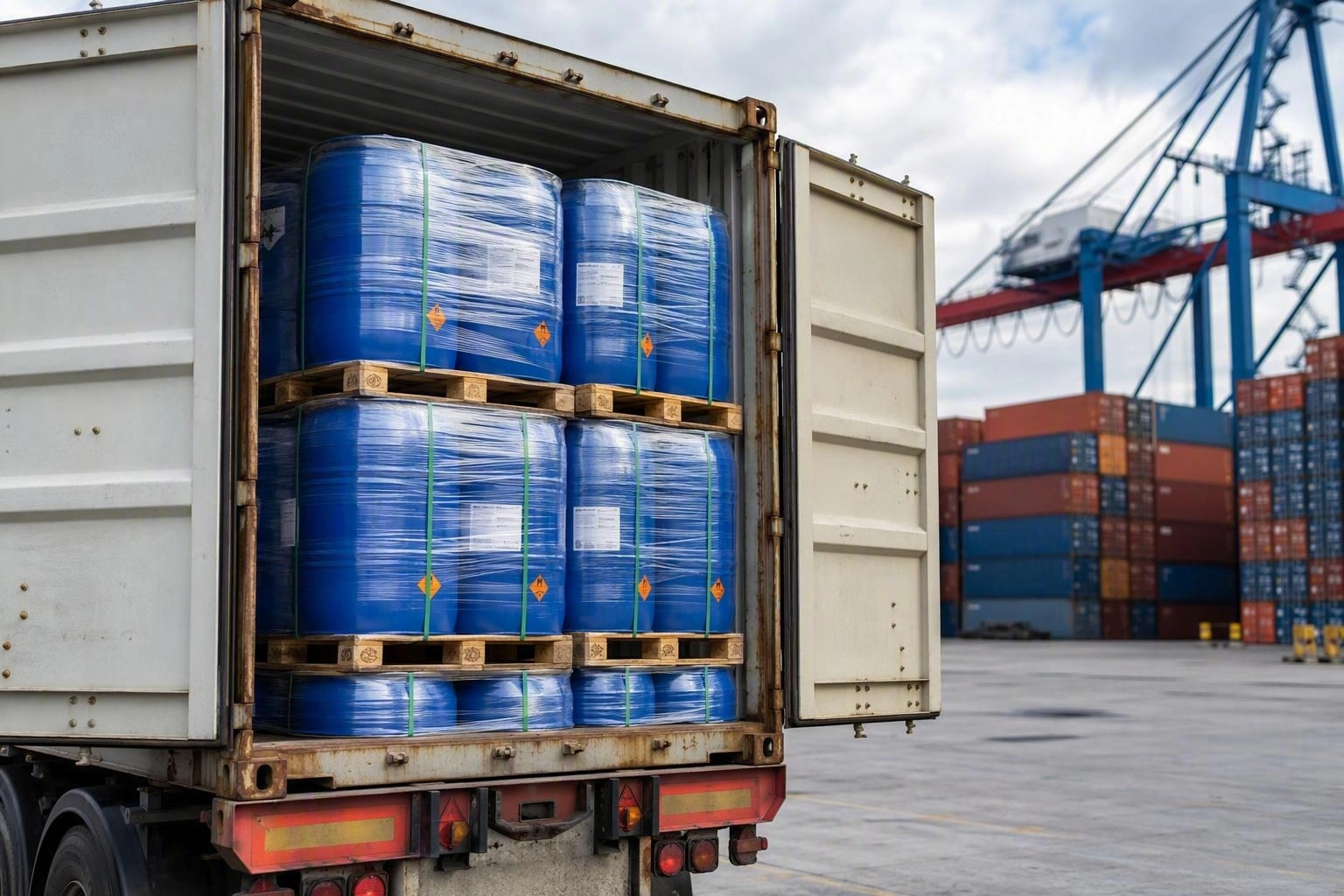
| Weight and packaging | 25 kg drums and 1000 kg IBCs are heavy and low-value-density, so freight is a large share of landed cost and worth controlling directly |
| Possible hazardous classification | Affects carrier acceptance, documentation, stowage, and insurance. Not every carrier accepts every class |
| Documentation requirements | MSDS in the required language, correct classification, and compliance documents (ISO, RoHS) may be required at import |
| Permit and registration rules | Some destinations require chemical registration or import permits obtained by a local entity |
| Storage conditions during transit | Products generally require cool, ventilated conditions and protection from direct sunlight and freezing — relevant to routing and transit time |
| Shelf life | Typically 12 months in the original sealed package. Long transit and clearance times consume shelf life, which matters on large orders |
The shelf life point deserves emphasis. A 12-month shelf life measured from production means that a slow sea transit plus a slow customs clearance can consume a meaningful portion of the product's usable life before it reaches your tank. Buyers planning large orders should factor this in, and should confirm the production date rather than assuming it.
A decision sequence
- Establish whether you can act as importer. If you have customs capability or an agent, FOB or CIF are open to you. If not, DDP is the practical route — but verify the seller can genuinely deliver it.
- Check the destination's import requirements for the specific chemistry. Classification, permits, registration. This should be resolved before choosing a trade term.
- Compare freight cost directly if your volume justifies it. For drummed chemical cargo at any real volume, a forwarder rate is usually better than an embedded one.
- Consider insurance separately. For chemical cargo, minimum cover is rarely adequate. If you have a blanket policy, FOB is the natural choice; if not, look at what the CIF insurance actually covers before relying on it.
- Confirm documentation deliverables in writing, whichever term you choose: MSDS, technical datasheets, compliance documents, commercial invoice, packing list, and certificate of origin where applicable.
- Confirm shipping method and transit time against shelf life. Air, sea, or express each imply different lead times and costs, and sea freight on a large order must be planned against the 12-month shelf life.
- State the delivery point precisely. Under DDP in particular, an undefined delivery point is a dispute waiting to happen.
What we offer
Foshan Changcheng Surface Technology Co., Ltd. exports metal cleaning agents, neutral rust removers, and metal film formers to customers in hardware processing, machinery manufacturing, electronics, building materials, and automotive sectors. We support air, sea, and express shipping with trade terms including FOB, CIF, and DDP, and we accept payment by T/T, L/C, PayPal, and Alibaba Trade Assurance. Proforma invoices and commercial invoices can be issued for customs clearance and payment.
Our factory is located in Guangdong, China, and visitors are welcome. ISO, MSDS, and RoHS documentation can be supplied as required, and electronic catalogues and product brochures are available on request. Tell us your destination, volume, and preferred trade term, and we will confirm what we can arrange and provide a quotation with the terms stated explicitly.

