

"Which degreaser should I use?" is the most common question we receive from production managers, and the honest answer is that it depends on two things: what the part is made of, and what is on it. Alkaline, acidic, and neutral cleaners are not interchangeable grades of the same product — they solve different problems, and choosing incorrectly produces either a costly two-stage process where one would do, or a surface that looks clean and behaves as if it is not.
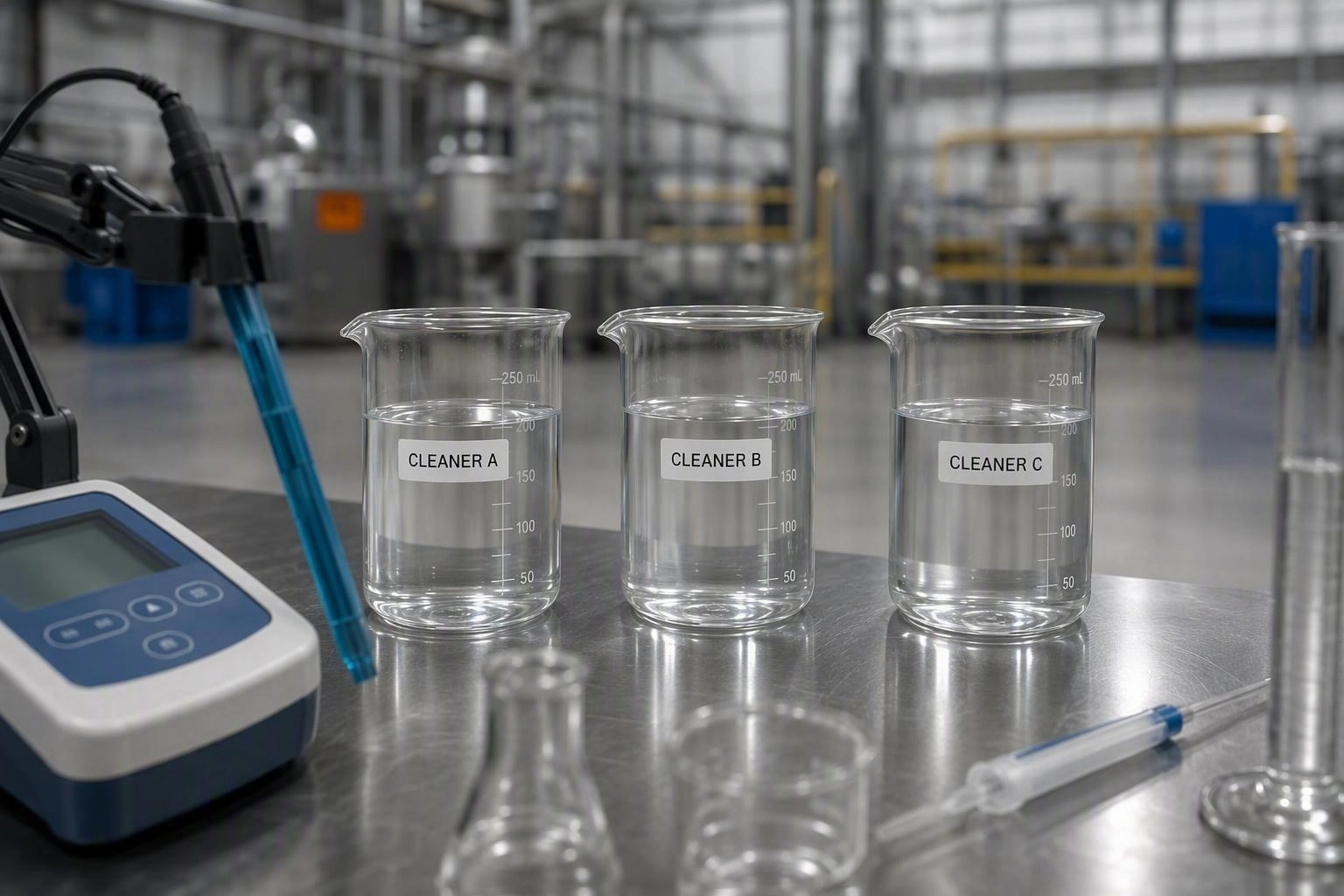
The three families at a glance
| Alkaline | Acidic | Neutral | |
|---|---|---|---|
| Primary mechanism | Saponification of fats and oils; emulsification; displacement | Dissolution of oxides, scale, and inorganic soils | Surfactant and chelant action; emulsification |
| Best at removing | Drawing oils, grease, machining coolant, wax, polishing compound | Rust, heat scale, smut, mineral deposits, light oxide | Light oils, fingerprints, dust, general shop soil |
| Attack on base metal | Low on steel; aggressive on aluminium and zinc if un-inhibited | Attacks steel and zinc; needs care on some alloys | Essentially none |
| Effect on surface | Leaves it active and water-wettable | Often brightens; opens the surface | Leaves it largely unchanged |
| Typical use temperature | 45–70 °C | Room temperature to 50 °C | Room temperature |
| Typical use | Stage 1 pre-clean before any coating | Derusting, descaling, or combined cleaning-derusting | Final clean, delicate substrates, short-cycle cleaning |
Alkaline cleaners: the workhorses
Almost every metal finishing line in the world starts with an alkaline stage, and for good reason. Alkaline chemistry saponifies animal and vegetable fats and emulsifies mineral oils, which is exactly what is needed to remove the drawing oil, cutting fluid, and polishing paste that metal parts accumulate during fabrication.
Alkaline cleaners are supplied either as liquid concentrates or as powders. The choice matters more than it appears:
- Liquid alkaline cleaners are easier to dose, dissolve instantly, and give more consistent bath strength. They are the better choice for automated lines and spray systems.
- Powdered alkaline cleaners often carry higher builder content and can be more economical at high soil loads, but require proper dissolution and are less suited to fine-nozzle spray equipment.
The critical constraint is substrate compatibility. Standard strong alkaline cleaners will etch aluminium, zinc, and galvanised surfaces, producing a dark, smutty appearance and consuming the cleaner rapidly. For these materials, either an inhibited alkaline product or a switch to neutral chemistry is required. On cast aluminium and die-cast aluminium, this is where many shops get into trouble — the part comes out clean but discoloured, and the discolouration has to be removed by a further step.
Alkaline strengths are matched to the job. LG607 Alkaline Degreaser and LG606 Alkaline Degreaser are formulated for steel workloads where saponifiable oil and heavy shop soil dominate. LG608 series degreasing solutions cover the broader cleaning duties around a phosphating or conversion coating line. LG610 Degreasing Agent is aimed at general production cleaning where a stable, easily dosed liquid is preferred. LG809 illuminant and LG808 Aluminum Spray Acidic Degreasing Agent address the aluminium spray-line case, where the cleaning stage must remove oil without attacking the substrate.
Acidic cleaners: when oxide is the problem
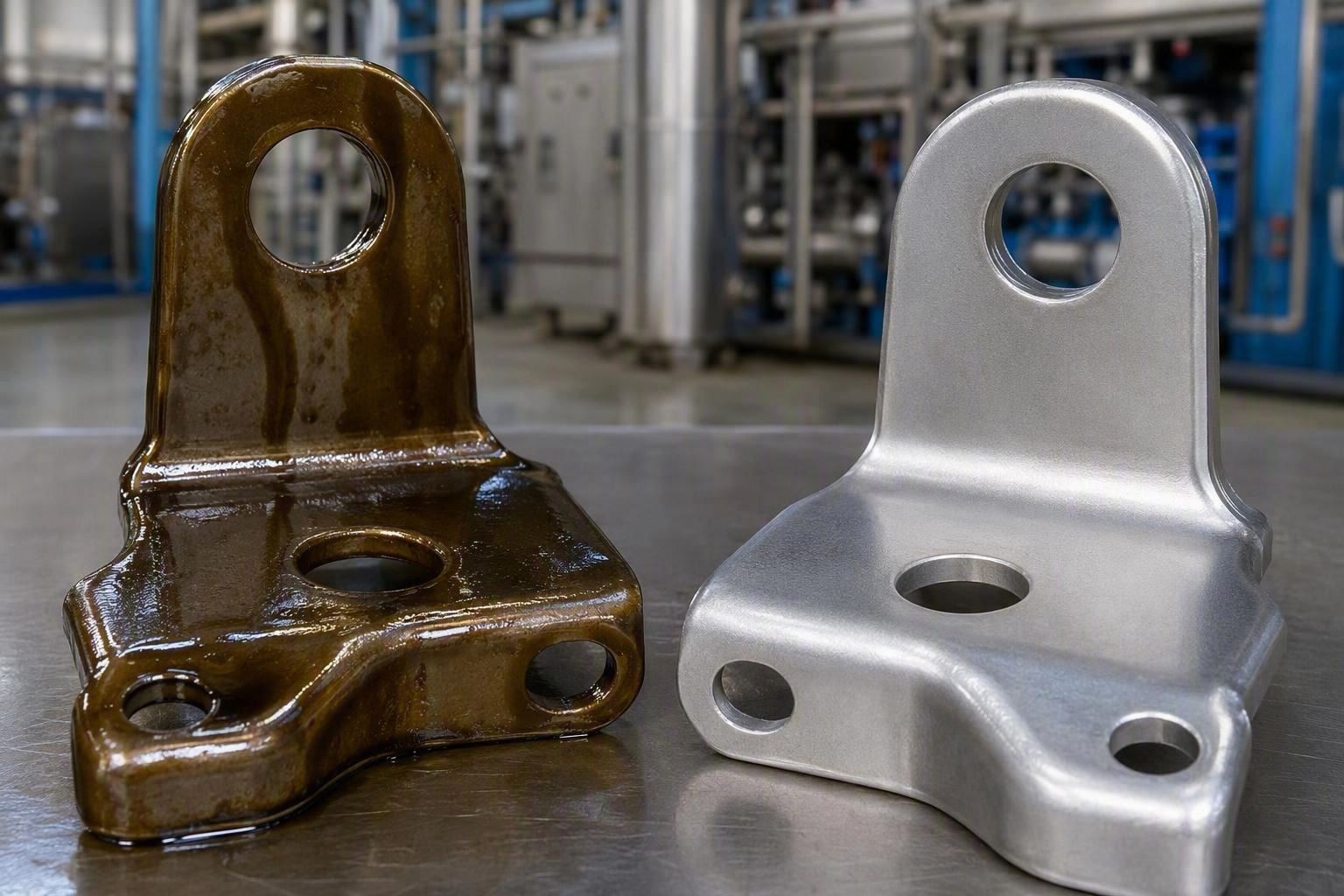
Acidic cleaners earn their place when the surface has more than oil on it. Rust, heat scale from welding, smut from pickling, and mineral deposits will not yield to alkaline chemistry. Acid dissolves them.
The trade-off is control. Acids attack metal, not just soil, so the same product that removes rust from a steel part will happily etch a zinc coating or attack an aluminium surface. Concentration, temperature, and immersion time all need to be inside the recommended window, and rinsing must be thorough.
Combined cleaning-and-derusting acids are efficient because they do two jobs in one tank, but they are best reserved for parts where the whole surface is uniformly affected. On partially rusted parts, the cleaned areas are exposed to acid for longer than necessary and can be over-etched or discoloured.
For stainless steel, acidic chemistry plays a different role. In a two-in-one passivation step, a mild acidic stage is what activates the surface by removing light oil and free iron before the passivation reaction takes over. This is the principle behind LG303 Stainless Steel Two-in-One Passivation Agent, which combines acidic degreasing (activation) with chemical passivation in a single immersion and is specifically formulated not to over-etch or dull the substrate.
Neutral cleaners: the precise instruments
Neutral cleaners operate near pH 7 and rely on surfactant and chelating chemistry rather than aggressive reaction. They are the right choice in three situations:
- Delicate or reactive substrates. Aluminium, zinc, magnesium, and plated parts can be cleaned without risk of attack. LG201 Neutral Cleaner is designed for this role, removing light oils and shop soil from sensitive surfaces while leaving the substrate untouched.
- Precision and electronics parts. Where dimensional accuracy or surface finish must not change, a neutral cleaner avoids any etching risk.
- Inter-stage cleaning. Between process steps, a neutral cleaner removes handling soil without resetting the surface chemistry of a previously applied treatment.
Neutral chemistry is also relevant on the protection side. LG202 Neutral Rust Remover removes light rust and oxidation without the aggressive etching of a strong acid bath, which makes it suitable for parts where dimensional tolerance or surface finish must be preserved — a distinction that matters enormously on machined components and precision hardware.
A related category sits between cleaning and protection: film-forming sealants such as LG912 Neutral Sealant, which build a thin protective layer from a near-neutral bath. These are not cleaners, but they are frequently specified in the same conversation, because a part that has just been correctly cleaned is the ideal candidate for a neutral sealing treatment.
A decision sequence that works
Rather than starting from chemistry, start from the workpiece:
- Identify the substrate. Steel, stainless steel, aluminium, die-cast aluminium, galvanised, zinc-plated, brass. This immediately rules out some options.
- Identify the soil. Drawing oil, machining coolant, polishing compound, wax, rust, scale, fingerprints. Heavy polymerised oil requires alkaline chemistry with sufficient temperature and time.
- Decide whether oxide removal is required. If yes, an acidic or combined stage is needed. If no, avoid acid — it adds etch risk for nothing.
- Check the downstream step. If a conversion coating or passivation follows, the cleaning stage must leave an active, water-wettable surface. Neutral cleaners are mild in this respect and may not activate the surface sufficiently for a phosphating reaction.
- Test with a water-break check. This is the single most useful production test. After cleaning and rinsing, the surface should hold an unbroken water film for at least 30 seconds. Beading means residual oil, and residual oil means every subsequent stage is compromised.
Three mistakes that cost the most
Using one cleaner for every substrate. A cleaner tuned for steel will eventually damage aluminium. If a line runs both, either use two products or specify a neutral/inhibited product that genuinely handles both — and verify it on scrap before committing.
Under-specifying temperature and time. An alkaline cleaner at 30 °C for two minutes will not remove the same soil as the same product at 60 °C for five. Operators often respond by increasing concentration, which raises cost and rinse load without solving the problem.
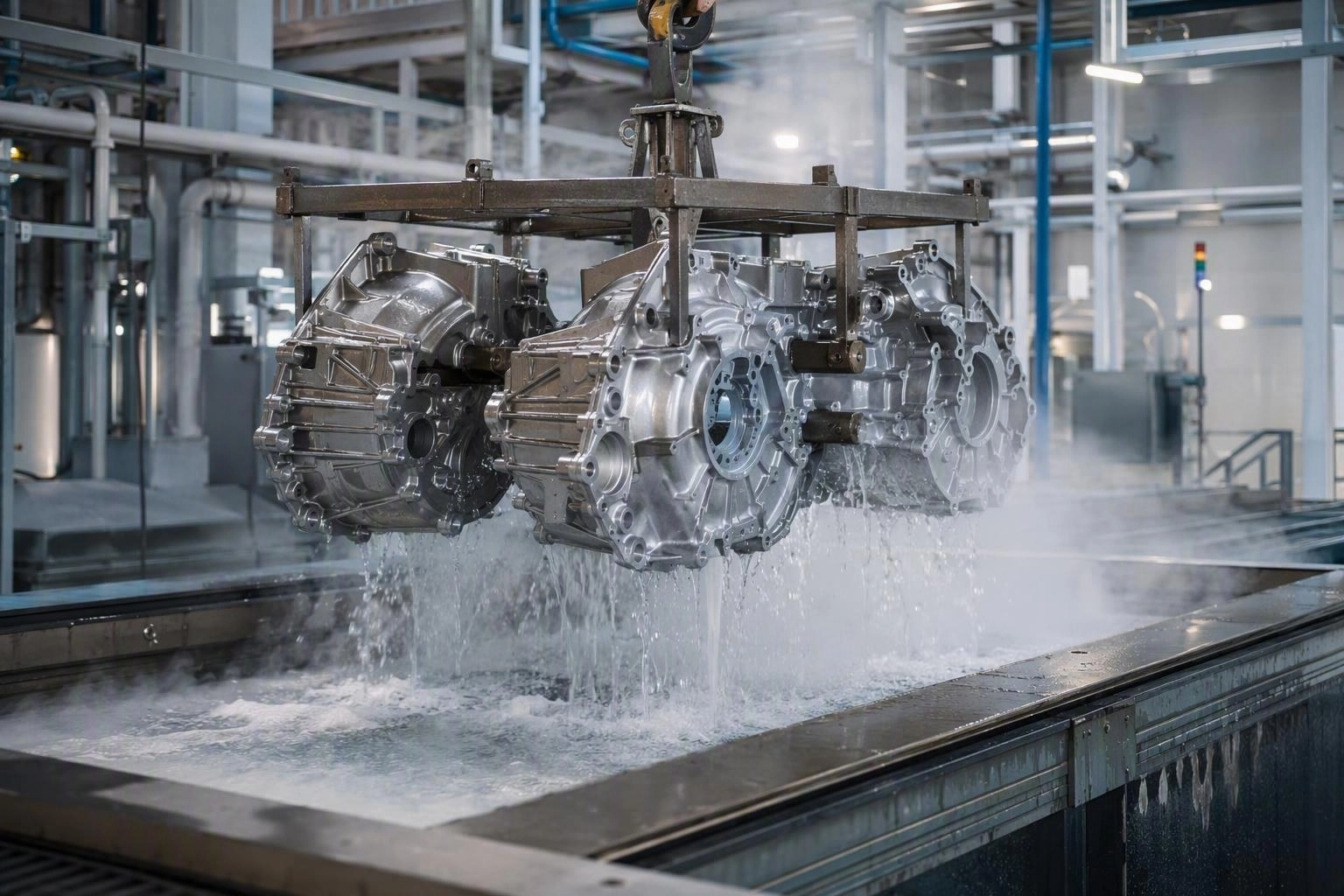
Neglecting the rinse. Cleaner residue carried into a passivation or conversion coating bath is a leading cause of inconsistent film and failed adhesion tests. Two-stage or counter-current rinsing costs little and removes an entire class of defects.
Getting it right the first time
Foshan Changcheng Surface Technology manufactures alkaline, acidic, and neutral cleaning chemistry across the full range, alongside the passivation, phosphating, and sealing products that typically follow. If you send us your substrate, your soil type, and your current line stages, we will recommend a starting product and dosage, and supply samples for trial on your own parts. Technical datasheets, ISO / MSDS / RoHS documentation, and electronic catalogues are available on request.


