

The quoted price per kilogram of a metal treatment chemical tells you very little about what it will cost to run. Two products at the same price can differ by a factor of two or more in cost per square metre of treated surface, depending on working concentration, drag-out losses, bath life, and how much of the product ends up in the wastewater plant rather than on the part. This article sets out a practical model buyers can use to compare offers on equal terms.
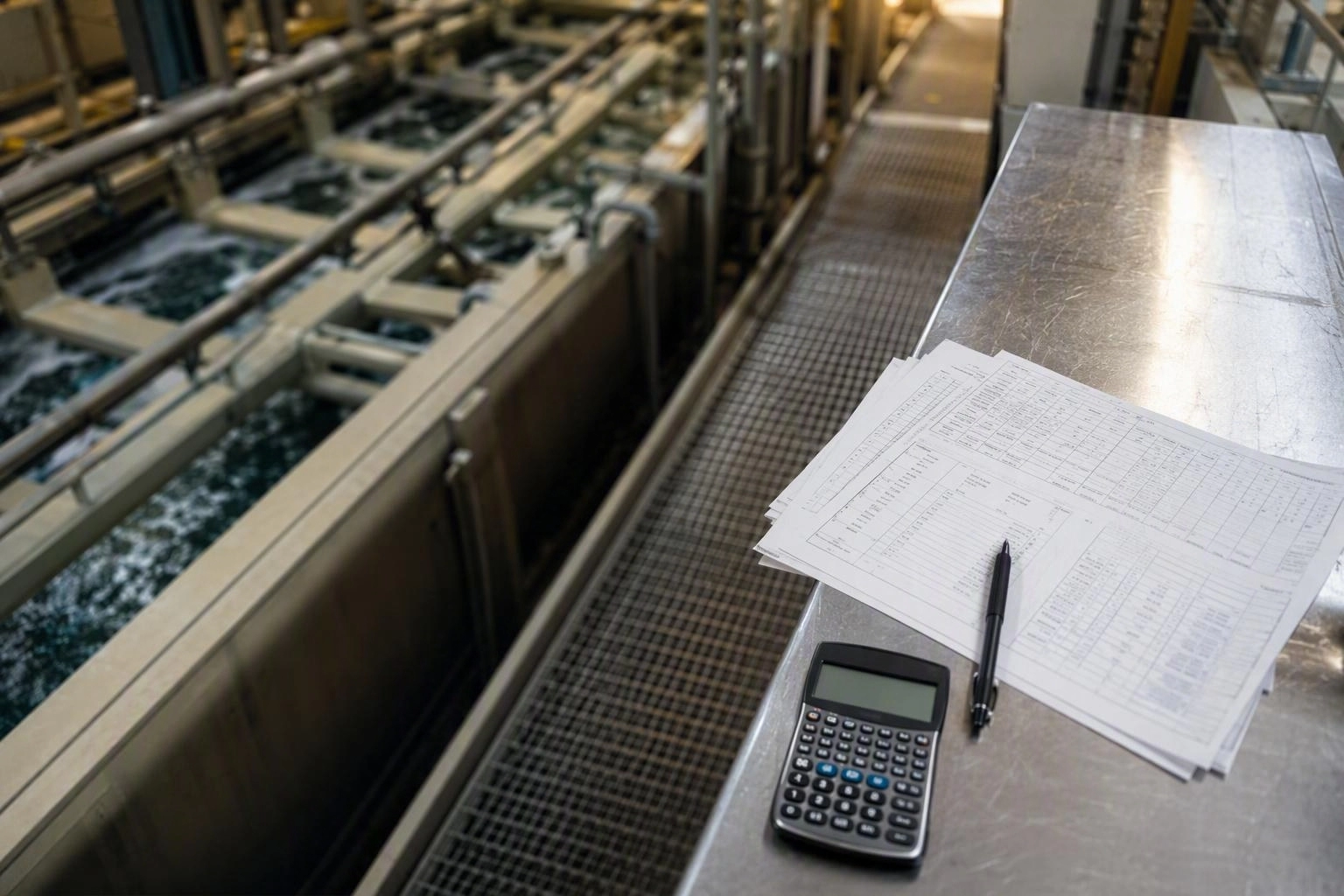
The cost per square metre equation
At its simplest, the total treatment cost per square metre breaks into four components:
Cost/m² = chemical consumption cost + drag-out loss cost + bath maintenance/dumping cost + utilities (heating, rinse water, waste treatment)
Most purchasing comparisons stop at the first term. Most of the practical difference between suppliers lives in the other three.
Term 1: Chemical consumption
Chemical consumption per square metre depends on three variables:
- Working concentration — expressed as a percentage of stock solution by volume, or in grams per litre for powders.
- Bath volume — determined by tank geometry and the largest workpiece, with typical allowances of 15–30 % freeboard.
- Replenishment rate — how much product must be added to maintain the working concentration as it is consumed by reaction and lost to drag-out.
The replenishment rate is the term that separates products on paper. A formulation with high chelating capacity and a stable active system maintains its working concentration over a longer interval, which reduces the volume consumed per unit of treated area. This is why a product that appears more expensive per drum can be cheaper per square metre.
A worked example
Consider a two-in-one treatment bath for stainless steel:
| Parameter | Value |
|---|---|
| Tank volume | 800 L |
| Working concentration | 50 % stock solution by volume |
| Initial charge | 400 L of stock solution |
| Daily replenishment (light oil load) | 3–5 % of tank volume = 24–40 L/day |
| Daily treated area | 180 m² |
| Chemical cost per litre (illustrative) | ¥X |
Daily chemical cost = replenishment volume × unit cost. Cost per square metre = daily chemical cost ÷ 180 m². Run the same calculation with the second supplier's concentration and replenishment figures and the ranking of the two offers often reverses.
For comparison purposes, a rinseable two-in-one passivation chemistry such as LG303 requires a 50 % working solution with a 5–15 minute room-temperature soak, which keeps the initial charge and the replenishment volume both predictable and relatively low compared with multi-stage alternatives.
Term 2: Drag-out losses
Drag-out is the working solution that leaves the tank on the surface of the workpiece and on the jig. It is invisible on a quotation and substantial in reality — typically 0.5 to 2 litres per square metre of treated surface for a jigged immersion process, depending on part geometry and drainage time.
Three factors control it:
- Part geometry. Hollow sections, complex castings, and parts that trap liquid have far higher drag-out than flat panels. Specify part geometry to your supplier — it changes the economics materially.
- Drainage time above the tank. Extending the dwell above the bath for 10–20 seconds reduces drag-out substantially at essentially no cost. This is the cheapest efficiency measure available on most lines.
- Working concentration. Drag-out cost scales directly with concentration. A 50 % working solution loses half as much active material per litre dragged out as a 100 % bath — one reason dilute, longer-dwell chemistries often win the cost comparison.
For spray processes, drag-out is minimal, but overspray losses and pump losses replace it as the dominant loss mechanism.
Term 3: Bath life and dumping
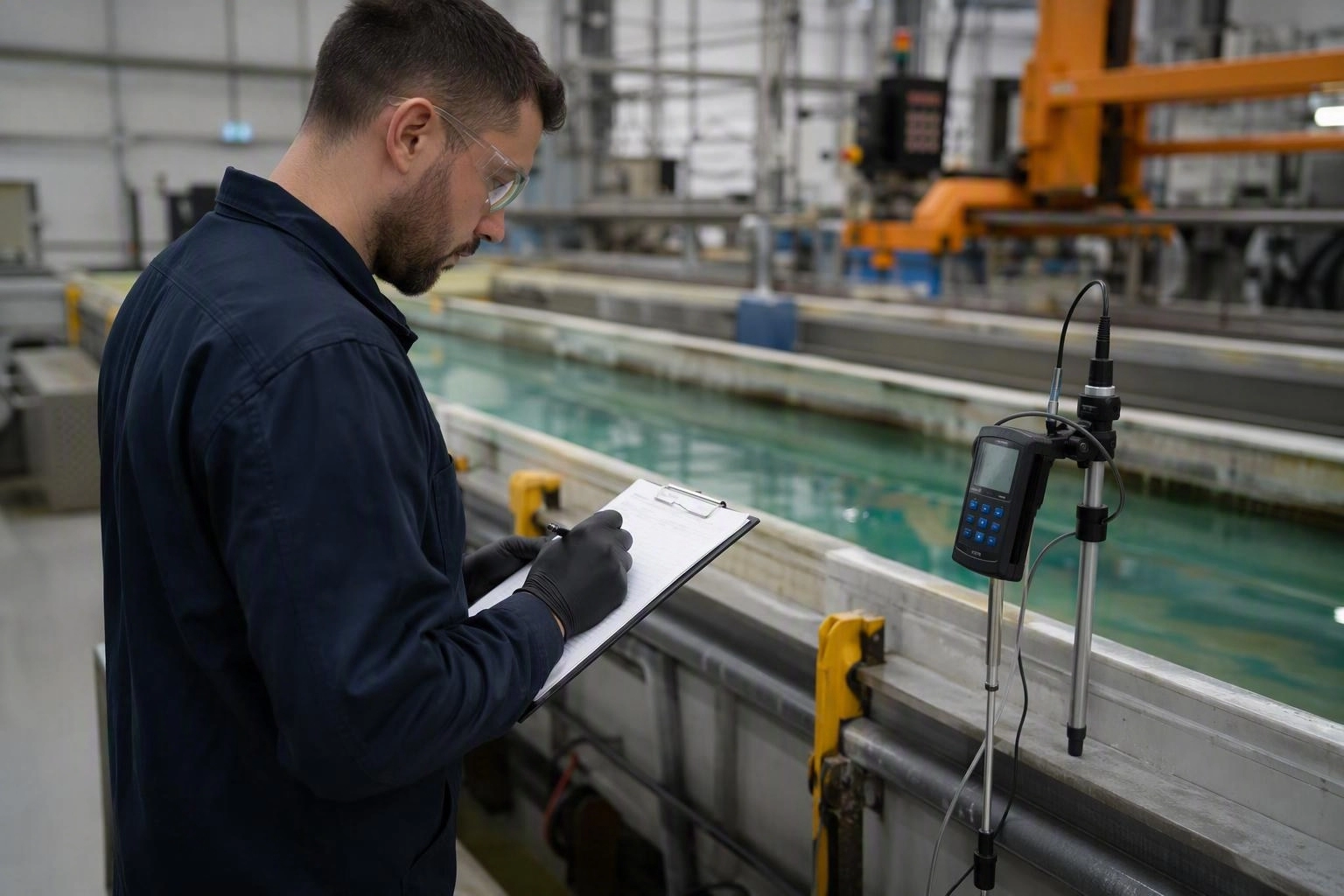
A bath does not last forever. Contaminants accumulate: oil emulsified into the working solution, dissolved metal ions, and breakdown products. Eventually the bath must be dumped and remade. The cost of a dump includes the chemical value of the discarded bath, the downtime to empty and recharge, and the waste treatment cost of the spent liquid.
Two product characteristics directly influence how often this happens:
- Contaminant tolerance. A formulation that tolerates a higher oil load before performance degrades extends the interval between dumps. Products such as LG912 Neutral Sealant and similar chemically buffered systems are designed around this property.
- Bath stability. Products that resist pH drift and impurity interference hold their performance longer. In two-component systems, the additive component exists specifically for this function: LG706 Two-in-One Degreaser and LG707 Two-in-One Degreaser act as functional regulators and stabilisers for their respective conversion coating partners, buffering impurity interference and extending main bath life.
When comparing offers, ask the supplier for an expected bath life in square metres per litre, or in weeks at a stated loading. A supplier who cannot answer this question has not modelled their own product.
Term 4: Utilities and waste treatment
The components that sit outside the chemical drum:
| Utility | Driver | Notes |
|---|---|---|
| Heating energy | Operating temperature × tank volume | Room-temperature processes eliminate this entirely |
| Rinse water | Number of rinse stages × flow rate | Counter-current rinsing cuts consumption sharply |
| Waste treatment | Discharge volume × contaminant load | Sludge disposal dominates on phosphating lines |
| Sludge handling | Phosphating in particular | Regular desludging labour and disposal cost |
| Drying energy | Final dry requirement | Blow-off before the dry oven reduces load |
This is where phosphate-free and room-temperature chemistries can win decisively. A silane pretreatment such as LG907 Silane Sealant runs at room temperature with minimal sludge, so the manufactured chemical cost is not the differentiator — the avoided sludge disposal and heating cost is.
Building the comparison
A practical supplier comparison table has a column per offer and the same rows for each:
| Line item | Supplier A | Supplier B |
|---|---|---|
| Working concentration | ||
| Tank volume required | ||
| Initial charge cost | ||
| Daily replenishment volume | ||
| Daily replenishment cost | ||
| Expected bath life (m²/L) | ||
| Operating temperature | ||
| Rinse stages required | ||
| Sludge generation | ||
| Waste treatment cost estimate | ||
| Total cost per m² |
The final row is the only one that matters. The rest exist to build it.
Practical measures that reduce cost per square metre
- Increase drainage time above the tank. Free, and it cuts drag-out directly.
- Install a drag-out rinse before the main rinse. A small static rinse tank recovers dragged-out chemistry back into the process and reduces the load on the rinse stage.
- Use counter-current rinsing. Cuts rinse water consumption by 40–60 % on multi-stage lines and reduces waste volume proportionally.
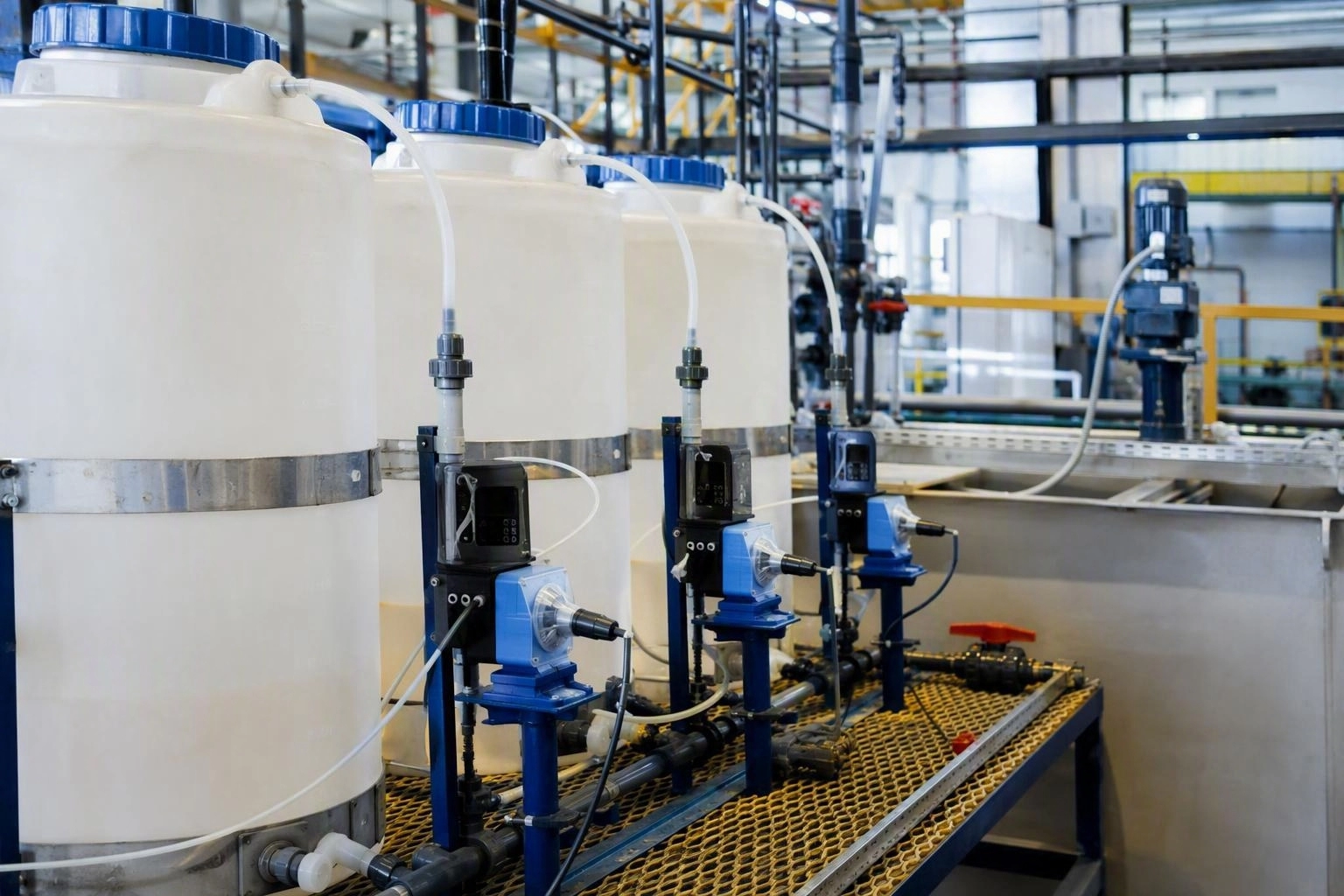
- Dose by measurement, not by feel. Dosing pumps with a control setpoint eliminate the common pattern of over-dosing to be safe, which is a direct cost with no quality benefit.
- Monitor bath life with a simple log. Track pH, concentration, and treated square metres per shift. Bath life becomes predictable, and dumping happens on schedule rather than in response to a quality failure.
- Consider a room-temperature chemistry. Removing heating from the process often changes the economics more than the chemical price does.
Getting an accurate quote
Foshan Changcheng Surface Technology will provide concentration, replenishment, and expected bath life figures alongside pricing so you can complete the comparison above. Send us your substrate, treated surface area per shift, soil type, line stages, and available temperatures — and we will return a costed recommendation rather than a bare price list. Technical datasheets, ISO / MSDS / RoHS documentation, and electronic catalogues are available on request.


