

Water marks, spotting, and flash rust are the most frequent quality complaints on metal finishing lines, and they share a single underlying cause: metal that was correctly treated is being allowed to dry in the wrong condition. None of these defects originate in the treatment bath. They originate in the rinse, the drainage, or the drying stage — which makes them almost entirely preventable at low cost.
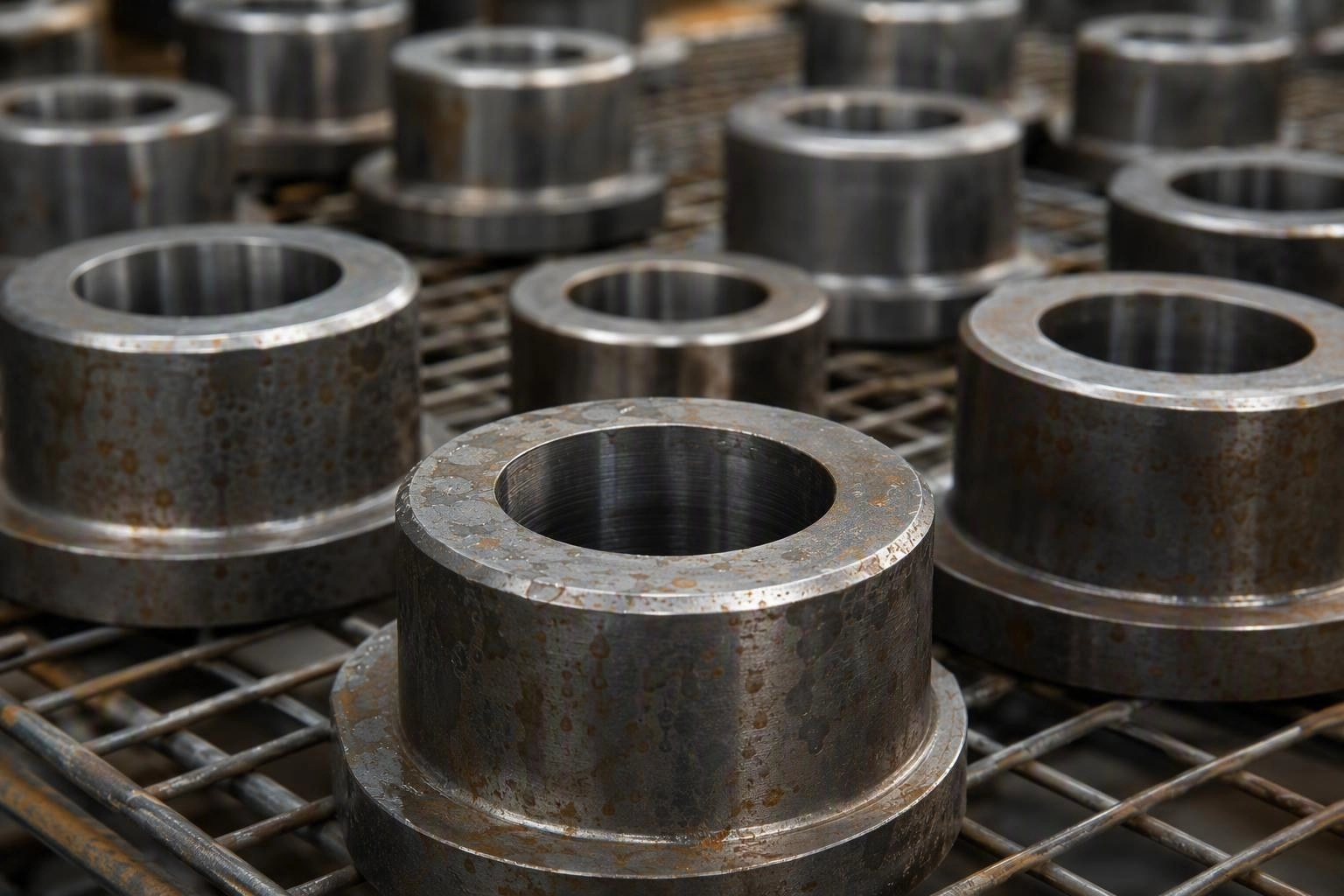
Recognising the defect before diagnosing it
The three defects look similar but have different causes, and treating them as one problem leads to the wrong fix.
| Defect | Appearance | Underlying cause |
|---|---|---|
| Water marks / spotting | White or pale ring-shaped deposits, often circular or map-like | Dissolved solids in rinse water left behind when the droplet evaporates |
| Flash rust | Light orange-brown surface discolouration appearing minutes to hours after drying | Active steel surface exposed to air and moisture with no protective film |
| Staining / discolouration on stainless | Brown or grey tint, sometimes in streaks | Residual contamination plus chloride-rich or high-solids rinse water |
| Streaking | Directional lines following drainage path | Slow drainage, high surface tension, or contact with contaminated racking |
Cause 1: Rinse water quality
Every litre of rinse water carries dissolved minerals. When the part dries, those minerals stay on the surface. At 200 mg/L total dissolved solids, a part leaving the rinse carrying 50 mL of water per square metre deposits roughly 10 mg of solids per square metre — invisible on a rough casting, clearly visible on a polished or bright surface.
Hardness (calcium and magnesium) is the main contributor to white spotting. Chlorides are worse: they not only spot, they actively attack the passive layer on stainless steel and accelerate corrosion. Silica leaves hard, difficult-to-remove deposits.
How to confirm: Ask for a rinse water analysis — total dissolved solids, total hardness as CaCO₃, chloride, and silica. Compare results from the final rinse tank with the incoming supply. Evaporating a measured sample of final rinse water in a clean dish shows the deposit directly.
The fix: Use deionised or reverse-osmosis water for the final rinse wherever bright or decorative finishes are required. This is standard practice in finishing shops producing visible parts, and it eliminates an entire class of defects. Where DI water is not available, at minimum use a clean, low-hardness supply for the final rinse rather than the same water used in earlier stages.
Cause 2: Incomplete drainage and slow drying
Water that stays on a surface for a long time does more damage than water that evaporates quickly. Prolonged contact allows dissolved oxygen and chloride to attack the metal, produces larger and more concentrated deposits, and leaves longer marks.
How to confirm: Inspect where the defects concentrate. Marks along the bottom edge of a part, at the lowest point of a curvature, or beneath hang points indicate drainage problems rather than water quality problems.
The fix: Three measures, in order of cost-effectiveness:
- Improve part orientation on the jig. Angle parts so water drains off rather than pooling. This costs nothing and solves a large share of the problem.
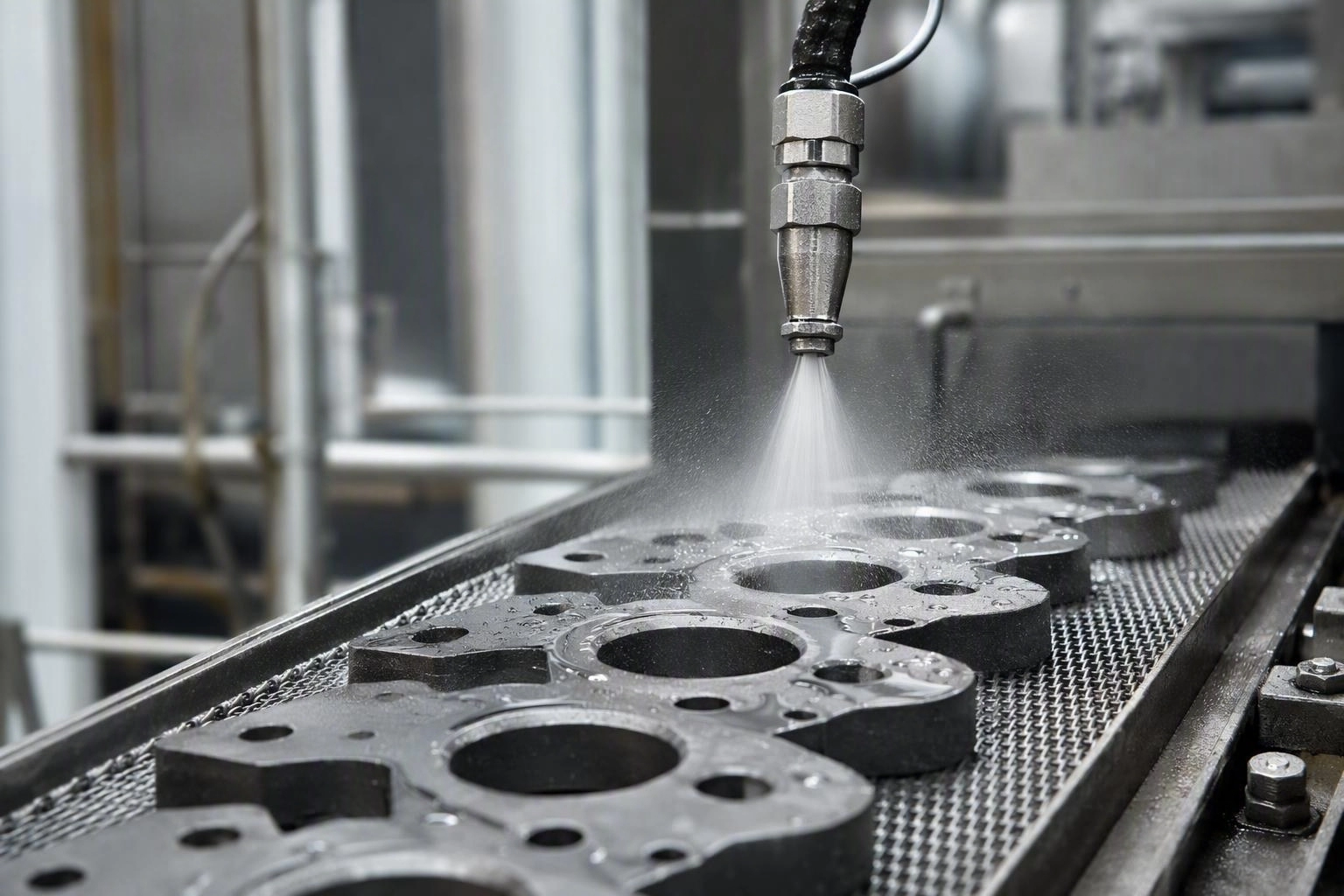
- Add a compressed air blow-off before drying. A blow-off knife or air nozzle removes the bulk of surface water in seconds, which dramatically reduces both the deposit load and the drying time.
- Dry promptly and adequately. Delay between rinse and dry is a direct contributor to flash rust on steel. Do not let rinsed parts sit wet in a rack waiting for the oven.
Cause 3: Flash rust on carbon and alloy steel
Flash rust is a distinct problem from spotting, and it is the more serious of the two. A freshly cleaned and rinsed steel surface is chemically active. In the minutes after rinsing, with no protection, it begins to oxidise. High humidity, warm conditions, and chloride contamination accelerate this sharply.
Flash rust typically appears in three situations:
- Between the cleaning rinse and the treatment bath. This is the classic case. Parts wait in a rack, still wet, and begin to rust before they reach the conversion coating or passivation stage. Once rust has formed, the treatment bath must remove it, which consumes chemistry and compromises film quality.
- Between the final rinse and drying. Especially on long lines with slow transfer.
- During storage after treatment. Particularly where a film is thin and short-term, or where parts are stored in a humid environment.
The fix, by location:
| Where it occurs | Corrective action |
|---|---|
| Between clean and treat | Shorten transfer time; add a rinse with a mild rust-preventive additive; or use a surface modifier stage to keep the surface active and protected (LG508 surface modifier is designed for this transition role) |
| Between final rinse and dry | Blow off water and dry immediately; avoid wet storage |
| During storage | Apply a suitable rust-preventive or sealing treatment; LG202 Neutral Rust Remover addresses light rust and oxidation without aggressive etching where rework is required |
Where flash rust has already formed and parts must be salvaged, the choice of removal method matters. A strong acid bath removes rust but also attacks the base metal and can change dimensions on precision parts. A neutral rust remover such as LG202 removes light rust and oxidation while leaving the substrate dimensionally intact — the appropriate choice for machined components and precision hardware.
Cause 4: Residual treatment chemical
Carry-over of treatment chemistry into the final rinse raises the dissolved solids load in that rinse, which makes spotting worse. The defect pattern is usually a visible film or streak rather than discrete spots, and it frequently concentrates in crevices and low points.
How to confirm: Measure the pH or conductivity of the final rinse tank and compare it with the incoming water. A significant shift indicates carry-over. Check whether the rinse tank is being changed frequently enough for the production rate.
The fix: Add or improve a drag-out rinse between the treatment tank and the main rinse. A small static recovery tank captures most of the dragged-out chemistry and returns it to the process, reducing both rinse contamination and chemical consumption. Extending drainage time above the treatment tank also helps directly.
Cause 5: Contamination from racking and handling
Racking that has been used for carbon steel carries rust and iron contamination onto stainless and aluminium parts. Contact points are where the marks appear. Bare-hand handling transfers salts and oils that attract moisture and promote localised corrosion.
The fix: Maintain separate racking and jigging for stainless, aluminium, and carbon steel work. Require clean gloves for all post-treatment handling. Replace or refurbish racking whose coating has broken down, since exposed base metal on the rack itself becomes a contamination source.
A corrective sequence that resolves most cases
- Confirm the defect type — spotting, flash rust, streaking, or staining. Each points to a different stage.
- Get a rinse water analysis. TDS, hardness, chloride, silica. Compare incoming supply against final rinse tank.
- Measure the final rinse tank for pH and conductivity drift to detect carry-over.
- Review drainage orientation and jigging. Fix pooling before spending money on water treatment.
- Add or improve the blow-off stage. Usually the highest-value single change.
- Check drying timing and temperature. Prompt, adequate drying, with no wet waiting period.
- Audit racking and handling. Segregate by material and enforce gloves.
- For carbon steel, address the inter-stage gap between cleaning and treatment — this is where flash rust most often starts.
Preventing the problem rather than fixing it
Spotting and flash rust are inexpensive to prevent and expensive to rework. A final rinse on low-solids water, a blow-off before the oven, correct part orientation, prompt drying, and segregated racking will eliminate the overwhelming majority of occurrences. Where parts must wait between stages, a surface modifier or a short-term rust preventive such as LG912 Neutral Sealant closes the gap.
Foshan Changcheng Surface Technology supplies cleaning, rust removal, surface modification, and sealing chemistry for the stages where these defects arise. Send us your defect description, material, process sequence, and rinse water data, and we will identify the most probable stage and recommend a corrective action. Technical datasheets, ISO / MSDS / RoHS documentation, and electronic catalogues are available on request.


