
When customers compare metal surface treatment suppliers, the first questions are usually about price, performance, and lead time. Regulatory direction rarely comes up until a customer's own market changes the rules. We have taken a deliberate position on that: we formulate for the regulatory environment we expect our customers to face, not the one they face today. This article explains what that means in practice, where the trade-offs sit, and how it affects what we supply.

The regulatory direction of travel is clear
Across the markets we serve, the same pattern repeats: restrictions on hexavalent chromium expand, phosphate discharge limits tighten, and documentation requirements grow harder to satisfy with informal supply chains. A customer who buys on price alone in year one frequently finds that the product they standardised on cannot be documented or shipped in year three.
The specific pressures, in the order we encounter them:
| Pressure | Where it comes from | Practical consequence for a buyer |
|---|---|---|
| Hexavalent chromium restrictions | RoHS, REACH, OEM restricted-substance lists, customer-specific standards | Chromium-based passivation becomes unsupportable in some markets |
| Phosphate discharge limits | Local wastewater and environmental permits | Phosphating lines face treatment cost or process change |
| Heavy metal content declarations | Customer compliance teams, customs | Documentation must be available on request, in the right language |
| Worker exposure standards | Occupational health regulation | Chemistry producing acid mist or toxic vapour becomes costly to operate safely |
| Documentation traceability | Customer audits, end-market compliance | MSDS, ISO, and RoHS evidence expected as a matter of course |
None of these pressures is a surprise, and none is moving in the direction of permissiveness. Formulating on the assumption that they will intensify is not a marketing position — it is a risk management decision for both us and our customers.
What "eco-friendly formulation" means concretely
The term is used loosely in this industry, so it is worth being precise about what we actually mean.
1. No nitric acid, hydrofluoric acid, or hexavalent chromium in the passivation range
Traditional stainless steel passivation frequently relies on nitric acid, sometimes with hydrofluoric acid addition, and passivation of zinc or aluminium often uses hexavalent chromium. All three carry significant hazards: severe acid burns, toxic and corrosive vapour, and — for hexavalent chromium — a substance that is restricted or prohibited across a growing list of jurisdictions.
LG303 Stainless Steel Two-in-One Passivation Agent is built on an organic acid and oxidant system instead. It contains no nitric acid, hydrofluoric acid, or hexavalent chromium. The practical consequences for the customer are not abstract: no toxic acid mist in the workshop, simpler wastewater treatment, and no restricted substance in the process stream that has to be declared and defended.
2. Chrome-free passivation as a genuine replacement, not a downgrade
The historical objection to chrome-free passivation was performance. Chrome-based chemistry was simply better in many applications, and customers accepted the compliance burden as the price of results. That gap has narrowed substantially.
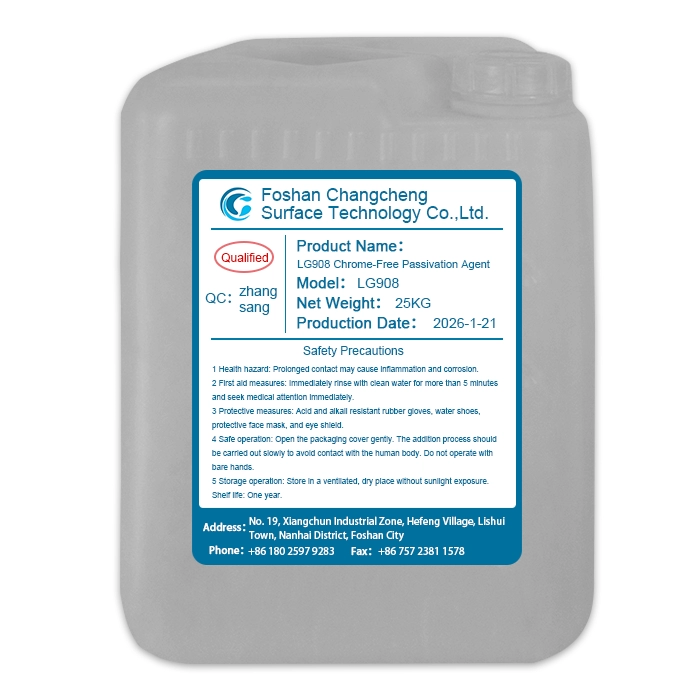
LG908 Chrome-Free Passivation Agent is specified for applications where a chromium-based process is being phased out, and it is designed to deliver the conversion-type protection and adhesion performance the application requires without the restricted substance. Where a customer's own customer imposes a chrome-free requirement, this is frequently the shortest route to compliance without re-engineering the whole finishing line.
3. Lower-hazard operation by design
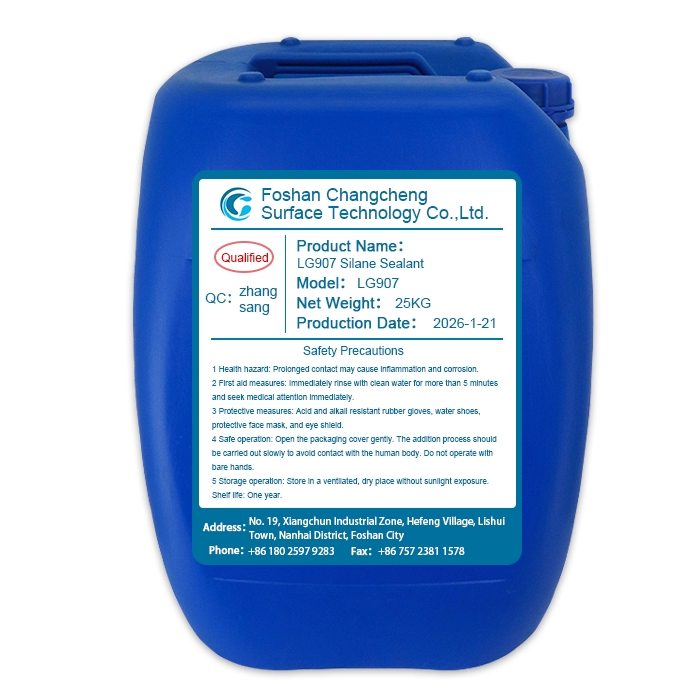
Some of our product range reduces hazard by choosing neutral operating chemistry where the application permits it. LG912 Neutral Sealant operates from a near-neutral bath, which simplifies storage and handling considerably compared with acidic alternatives. LG907 Silane Sealant builds its film from a room-temperature aqueous bath with no sludge generation — no phosphate, no heavy metals, and minimal waste treatment load.
The value here is operational, not merely environmental. Chemistry that is safer to handle is cheaper to operate: less personal protective equipment burden, fewer containment requirements, lower insurance and compliance overhead, and fewer incidents that stop production.

The honest trade-offs
We would be doing customers a disservice by presenting eco-friendly chemistry as a free upgrade. There are real trade-offs, and buyers should know them before specifying.
| Trade-off | Detail | How we manage it |
|---|---|---|
| Process window can be narrower | Some green chemistries are more sensitive to temperature, concentration, or contamination than their traditional counterparts | Provide explicit operating windows and control guidance, not just a datasheet |
| Performance equivalence is application-specific | Equivalent in most applications is not the same as equivalent in every application | Test on the customer's own parts before committing; be direct when a traditional product is the better answer |
| Bath life and stability must be engineered | Substituting the active system changes the bath's behaviour, requiring deliberate stabiliser design | Two-component systems and stabilising additives where needed |
| Cost may be marginally higher on some items | Raw materials for compliant systems are not always cheaper | Offset against reduced waste treatment, less PPE, and lower compliance overhead |
| Customer-side requalification | Changing a process may require re-validation against a customer specification | Provide documentation and trial support to make requalification straightforward |
We are also direct with customers about when a traditional formulation remains the right answer. There are applications where the performance requirement is exacting, the regulatory environment is permissive, and the customer is fully aware of the implications. Recommending a change there would not be honest, and it would not be in the customer's interest either.
What this means for buyers
Three practical implications for anyone specifying metal surface treatment chemistry:
- Ask about restricted substances before you standardise, not after. Once a process is qualified with a customer, changing it is expensive and slow. Choosing a formulation that will still be supportable in three years avoids that cost entirely.
- Require documentation as a standard deliverable. ISO, MSDS, and RoHS documentation should be available as routine, in the requested language, without a special request. If a supplier cannot supply them promptly for a stock product, that is a signal worth heeding.
- Evaluate the whole operating cost, not the drum price. Lower-hazard chemistry frequently reduces waste treatment cost, PPE consumption, and incident risk — items that never appear on a quotation comparison but do appear on the P&L.
Our position, stated plainly
We formulate with an explicit preference for organic acid and oxidant systems over nitric and hydrofluoric acid, for chrome-free passivation over hexavalent chromium, and for room-temperature, low-sludge processes where the application allows. We do this because we expect the regulatory environment our customers operate in to keep tightening, and because chemistry that is safer to operate is generally cheaper to operate as well.
We also supply established formulations where they are demonstrably the right answer, and we will say so when a customer's application genuinely requires one. The objective is not to sell a philosophy. It is to make sure a process still works in three years.
Working with us
Foshan Changcheng Surface Technology Co., Ltd. manufactures metal cleaning agents, neutral rust removers, and metal film formers for iron, aluminium, cast aluminium, galvanised, and magnesium-plated parts. Our product range covers chrome-free passivation agents, ceramicizing agents, silane sealants, alkaline and acidic degreasers, neutral cleaners, phosphating agents, surface modifiers, and demolding agents.
ISO, MSDS, and RoHS documentation can be provided as required, and electronic catalogues and product brochures are available on request. To discuss a specific application, send us your substrate, current process, and compliance requirements — we will recommend a product and supply samples for trial.